February 1, 2022

Birth Stories for Books: ZHANG HENG AND THE INCREDIBLE EARTHQUAKE DETECTOR, by Randel McGee

Hello readers! I have a very unique and inspiring path to publication story to share with you in today's edition of Birth Stories for Books. My guest today is the multi-talented Randel McGee, author/illustrator of  ZHANG HENG AND THE INCREDIBLE EARTHQUAKE DETECTOR (Familius, November, 2021). 

Book Cover by Randel McGee

Dawn Prochovnic: Welcome to the blog, Randel. I’m really excited to learn more about how your fascinating book, ZHANG HENG AND THE INCREDIBLE EARTHQUAKE DETECTOR came to be.

Randel McGee: Thank you, Dawn! I am excited to share this story,  and how it came to be, with you and your readers. 

DP: I understand from reading some of what you’ve shared on social media that this book took about five years (and thousands of shreds of paper bits) to create. I’d love to hear more about what inspired you to share ZHANG HENG’s story and what motivated you to make such a significant artistic commitment to move the idea forward to fruition.

RM: I had been commissioned to create a performance for California schools on the science of  earthquakes using stories that the students could relate to. I researched the back stories of scientists who had studied  the causes and effects of the geological forces that are involved with movements in the earth. I read legends and myths that tried to explain why the earth shakes at times. I read personal accounts of people who lived through devastating earthquakes and included some of my own memories of earthquakes. I distilled some of these stories into a school presentation.

I discovered the story of Zhang Heng and his incredible earthquake detector during that research. I learned that he was a true genius, a man of many talents, and yet humble. He was favored by the Emperor of China, but there was a great deal of jealousy and intrigue among the emperor’s court members. I thought that this would be a great story to share, a tale of succeeding despite opposition. I realized that the story was not well-known in the Western Hemisphere. As a puppeteer and artist with a lot of experience with shadow puppetry and paper-cut art, I thought that it would be interesting to present the story in the form of a traditional Chinese Shadow Theater show. 

DP: Wow, Randel. I love how one opportunity fueled another, and how your fascination with the topic paved the path for this project. 

You’ve shared some about your artistic process on social media, but I’d be delighted if you’d recap some of that here. In particular, I’d like to learn more about what transpired in the time between your initial idea for the book and the manuscript/proposal that was formulated fully enough to submit to an editor. 

RM: I had the good fortune to live close to the offices of Familius Publishers in Central California. I was able to arrange a meeting with the art director at that time, David Miles.  I was pitching a craft book of puppet projects that a friend and I had co-written. I was introduced to the founder of Familius, Christopher Robbins. They were not interested in the puppetry book at that time. However, I took some of my other art work, including my paper-cuttings and showed them those. They were interested in the illustrations and asked me to submit some proposals. I had just finished the script  for the Earthquake presentation and had not been able to use the Zhang Heng story there, so I proposed this story a few weeks later with a few examples of shadow puppets, both my own and images from other sources. The Zhang Heng story was appealing to them because it had elements of history, science, positive character traits, and then of course the traditional art that is visually exciting, but rather unknown to Western audiences. 

Christopher and David suggested I write a draft of the story and a storyboard for the illustrations. They told me how many pages I would need to illustrate, including some 2-page spreads. So I set to work doing some rough sketches. I went a bit beyond the storyboard concept by adding color to the scenes. I would submit the sketches through emails and occasionally would meet with David and Christopher, and Christopher’s wife, to layout the pages and get their feedback.

I was soon working with some talented story editors on the written story itself. They would help with the flow of the story and make suggestions on how to make certain parts of the narrative more understandable. All of this was done through emails as the editors were spread out around the USA. 

An interesting side story: I was performing in Taiwan and was able to see a model of the earthquake detector in a museum and that helped to inspire me to share the story.  I took several photos of the device. One is included as a background below.

Image Source, Randel McGee

DP: This is such an inspiring backstory, Randel. I particularly love how you continued to build on your interests and expertise to land on a project that was a good fit. Your story really demonstrates the importance of flexibility, determination, and creative vision on the path to publication.  

When you compare one of your earliest drafts of this story to the version in the published book, what stands out for you in terms of what is most different? Likewise, is there anything in particular that stands out that was included in your earliest drafts and survived the revision process?

RM: What stands out the most for me are the changes I made in the illustrations as the project progressed. As I looked at the storyboard sketches I realized that many looked rather static or still and did not give a sense of movement or drama that you would see in a puppet show. For example: There is a scene in the story where the jealous courtiers are spying on Zhang. I originally sketched a head peeking above a window frame as Zhang was working in the foreground. I ended with putting 3 men outside Zhang’s window, one comically trying to boost the other to peek inside and the third trying to steady the “booster”. In another scene I had a dramatic view of dragons surging up from the ocean causing tidal waves and shaking a village on shore. However, I thought I needed to show the dragons shaking the ground more directly, so I put fighting dragons in a cave beneath a village. 

Image Credit: Randel McGee / Familius

The picture I made of Zhang riding up to the imperial palace in an ornate, horse-drawn carriage was an early piece I made that was included in the final publication. The carriage was one of the first “puppets” I made. The palace was an early construction and includes Emperor An-Ti with his young heir Shun-Di welcoming Zhang.  A brief reference to An-Ti at the beginning of the story was removed since the focus was on his son Shun-Di. 
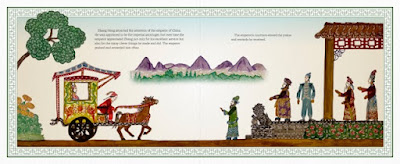
Image Credit: Randel McGee / Familius

DP: Thanks for sharing these details! 

When you compare the path to publication for this book to the paths to publication for one or more of your other books, (such as your many “how-to”  books on paper crafting), what are some of the key similarities and differences in terms of the publication journeys for each?

RM: My craft books came to be after a publisher saw me at the ALA convention in 2005 , which celebrated the Bi-Centennial anniversary of Hans Christian Andersen’s birth.  I was performing my Andersen act where I tell stories and make elaborate paper cut designs to illustrate the stories just like  Andersen would do. The publisher was impressed with my paper crafting and approached me about doing a series of craft books. OF COURSE I ACCEPTED! I was then put in touch with their editors who sent a list of holidays that they wanted to feature. I sent back a list of 12 - 14 possible crafts for each holiday with sketches of how they would look and they selected 8 projects from that list. There was a lot of interaction with the editors on those books regarding the content of the historical backgrounds of the holidays, and a lot of work on describing the “how-to” instructions of the crafts themselves. 

Similarities are the process of working with an editor to make sure the text is grammatically sound, clear in its meaning, and flows easily for the reader. Differences would be that the craft books required a lot more work on the text to ensure that the instructions were understandable. I think we have all seen instructions that left us scratching our heads and asking Huh? 

DP: As a reader, I definitely appreciate when instructions are written with care!  

Back to paper cutting, I'm curious to learn how you developed an interest (and proficiency!) in paper cutting art? I’m especially intrigued about this because this art form seems like such a solitary endeavor, particularly when compared to the many different forms of performance art that you are known for, such as storytelling, puppetry, and ventriloquism.

RM: There are a lot of cross-over aspects in the arts! One art form leads to another. I was working a lot with small shadow puppets on an Over-Head Projector (remember those from school?) and a friend showed me a book of traditional paper-cut scenes and designs. I saw the correlation between the paper-cuttings and the shadow scenes I was making and started learning more about that art form. I soon combined my storytelling with cutting simple figures and scenes to illustrate my stories. My audiences found this very intriguing, so I added more stories and designs. I called my act “The Storycutter.” I discovered that H.C. Andersen was also a “storycutter,” so I developed an act using his stories.  

DP: This is really inspiring, Randel. I'm really taken by how you have built a creative career by following new interests and curiosities. I'll bet bet your spirit of curiosity is especially inspiring and impactful for the young audiences you regularly work with. 

Speaking of which, one of my favorite parts of being an author is connecting with young readers at school, library, and bookstore visits, and I’m always looking for new pro tips. Given your vast experience in performance art and entertainment, what professional advice or suggestions do you have for fellow author/presenters in terms of planning successful (in-person and/or remote) book events? 

RM: I have worked as a performing artist, mostly in schools and libraries, for over 40 years. Anytime you are in front of an audience you are “performing.” You need to establish a character or persona onstage. I have seen many other authors do presentations. Some were very successful and others not so. Authors who did illustrations brought Powerpoint shows or even large sketch pads to show how they made the art. Kids, and adults, love to see how a drawing comes together! An author who wrote, but did not illustrate, brought photos of her home and family and talked about how she worked at writing with all the other things that went on in her life. They were aware of their audiences level of attention and “played” to that.  My advice is to keep the program moving along at a brisk pace, have visuals to show, give pointers of how to make  art or write a good story, have some interaction with the audience with Q&A or other participative activity, know your audience’s age level and work to that with respect.  

DP: Fantastic advice! Thank you!

Your online bio indicates that you incorporate original songs into your educational programs. One of my favorite creative experiences has been collaborating with music professionals to create original songs and videos for my picture books (you can view a recent collaboration here.) I’d love to hear more about your work as a singer/songwriter, including where folks can go to hear your music, and/or any plans you have for bringing together these two forms of creative expression. 

RM: Dawn, your video is lovely! The music sets such a beautiful mood for the story and the pictures are so endearing! Thank you for sharing that! 

DP: Thank you for your kind words! (That beautiful music comes from the wildly talented Maiah Wynne, and those gorgeous pictures are the handiwork of illustrator extraordinaire, Alice Brereton.)  

RM: I am a self-taught musician and feel that I have limited skills as such. I have some of my songs on Youtube. However, I have not been as diligent at getting them out there as I should have been. I do hope to animate some of my songs with shadow puppets during this next year and share them on Youtube. 

DP: If you could go back in time, what would you tell your pre-published self? Or, said another way, what do you know now, that you wished you would have known a bit earlier?

RM: Just send stuff out in the world. Keep working on it. Keep sharing what you do in as many good places (there are some places that are not worth your efforts) as you can and something will open up.

I have held myself back by thinking I was not good enough to make it past the cold submission stage. I was fortunate enough to be in good places at the right time. As we say in show business: “Timing is EVERYTHING!” 

DP: More fantastic advice. Thank you!

Is there something you wish someone would ask you about your path to publication for ZHANG HENG AND THE INCREDIBLE EARTHQUAKE DETECTOR that you haven’t had the opportunity to share yet? 

RM: “Did you actually cut all those little spaces by hand?” - Yes! I went through dozens of razor-sharp, pointy blades to cut all those tiny shapes out of the shadow puppets to make them look like Chinese style puppets. I wear magnifying glasses when I cut because some of the cuts are very small, but the end result is worth the trouble.

DP: Readers, if you want to see some amazing photos of Randel's artistic process, you can find a photo journal here.

Do you have anything you’d like to tell us about what you’re currently working on? 

RM: I am always working on something, whether it is for a friend or just an experiment on some new style. 

DP: Thanks so much for sharing your Birth Story for ZHANG HENG AND THE INCREDIBLE EARTHQUAKE DETECTOR with us, Randel!

RM: Thank YOU, Dawn.

Friends, the best way to thank an author whose insights and experiences have been helpful and/or inspiring to you is to support their work. Buy their books. Request them from your library. Read and share them with others. You can find Randel's work in all the usual places, including Bookshop (and ZHANG HENG AND THE INCREDIBLE EARTHQUAKE DETECTOR can also be purchased directly from Familius.)

********** 

Image Source: Randel McGee
Randel McGee is a versatile writer and entertainer with over 40 years of professional experience. His book series Paper Craft Fun for Holidays and Fun and Festive Crafts for the Seasons, are in schools and libraries throughout the world. He recently wrote and illustrated Zhang Heng and the Incredible Earthquake Detector with Familius Publishers. 

As a professional storyteller and ventriloquist, Randel has performed all around the USA and Asia at schools, libraries, conferences, and special events. His ventriloquist act of Randel McGee and Groark (the dragon) has two award-winning DVD series on character education for elementary school children. His storytelling performances as the world-famous author Hans Christian Andersen has taken him to storytelling festivals and cultural events around the globe.

He is also a popular workshop director on a wide range of subjects from storytelling techniques to effectively integrating performing arts into public education. He has worked with students (from kindergarten through college), teachers, and librarians, from all over the USA and Asia. 

For more information about Randel McGee’s shows, workshops, and writings please visit www.mcgeeproductions.com or contact Randel at randel at mcgeeproductions dot com.


**********

Birth Stories for Books is an occasional feature of Dawn Babb Prochovnic's blog. Dawn is the author of multiple picture books including, Lucy's Blooms, Where Does a Cowgirl Go Potty?, Where Does a Pirate Go Potty?, and 16 books in the Story Time With Signs & Rhymes series. Dawn is a contributing author to the award-winning book, Oregon Reads Aloud, and a frequent presenter at schools, libraries, and educational conferences. Contact Dawn using the form at the left, or learn more at www.dawnprochovnic.com.  

January 19, 2022

Birth Stories for Books: Just Like Flowers, by Jenny Jiang

Hello readers! It's time for our first Birth Stories for Books interview of the new year. Today's guest, Jenny Jiang, shares her experience self-publishing her debut picture book, JUST LIKE FLOWERS, which came out in September of 2021.

Image Credit: Jenny Jiang

Dawn Prochovnic: I’m so glad to have you on the blog, Jenny, and I’m really looking forward to learning more about your debut picture book, JUST LIKE FLOWERS. 

Jenny Jiang: Thank you so much for having me! I’m really excited to share the Birth Story for "Just Like Flowers."

DP: I’d love to hear how the idea for this story came to be. Reading your bio on Amazon, I understand that you noticed the lack of representation in children’s literature and wanted to embark on a book-making project as a way to do something about it. Can you share more details about what motivated you to move the idea forward to fruition?

JJ: Of course! I embarked on this project my junior year of high school in December 2020, when I organized a winter-themed Zoom event with elementary schoolers in the Portland area. Before the event, I explored a LOT of children’s books for the storytelling station. When I flipped through the pages, my artist’s eye noticed the lack of diversity in the characters. After the event, I went to the School Library Journal, which confirmed the invisibility of children of color in children's literature: only 25% of picture books include children of color. 


Infographic Source: School Library Journal

This realization triggered my favorite picture books as a child: Pinkalicious, Fancy Nancy, Knuffle Bunny. As an Asian American, my younger self didn’t feel a connection to any of the white-illustrated characters in these books. When children of color view literature without characters that look like them, they internalize this omission as a devaluation of their importance. The underlying cause of the underrepresentation is the lack of authors of color.

When I saw the smiles of the children of color I read to, my heart urged me to step in and make my own children’s book with children of color. This is how “Just Like Flowers” started. This picture book features an Asian American girl as the main character with different races as side characters. The book is perfect for children of color to read to see themselves in a picture book and also helps white children embrace multiculturalism.

Image Credit: Jenny Jiang

DP: What an inspiring back story! How impressive that you took such deliberate and prompt action to address a problem in the world! (As I mentioned in one of our email conversations, for folks who are likewise interested in working to address the lack of representation in children's literature, We Need Diverse Books is a great place to get started: Web, IG, and Twitter.)

I’m curious how you came to the idea of exploring "the value of human differences through the unique metaphor of flowers.” I’ve written in previous blog posts about how this metaphor likewise played a role in the inspiration for my picture book, LUCY’S BLOOMS. Was there a distinct interaction or experience that inspired you in the direction of this particular metaphor for human diversity?

JJ: Lucy’s Blooms is such an adorable picture book! 

DP: Thank you!

JJ: For "Just Like Flowers," I heard a really beautiful quote in a movie: “the next time that you see a flower, just remember that part of what makes it beautiful is how long it took to grow.”

I wanted to center my picture book around appreciating human differences, ranging from race, height, and body shape. My goal for the book was to combat beauty standards and spread the message that every feature is beautiful.

I knew that books teaching this already existed out there, so I wanted my book to teach this message in a unique way. As I looked at picture books online, I figured the best way to uniquely teach this lesson is to develop a metaphor that I create. I remembered the quote in the movie, and my mind started making root connections.

I connected the beauty in flowers, a concept kids intuitively understand, to the beauty in humans. I looked at all the types of flowers as if they were people. Flowers have different colored petals and take on different shapes and heights, just like humans. As I started the brainstorming process, the metaphor kept blossoming.


Image Credit: Jenny Jiang

The metaphor took a long time to grow, but I think it blossomed perfectly as it approaches appreciating human diversity in a new way.

DP: Wow, Jenny! That's a fantastic example of how the seed of an idea can germinate and take root! Thank you so much for sharing that. 

When you compare one of your earliest drafts of this story to the version in the published book, what stands out for you in terms of what is most different? Likewise, is there anything in particular that stands out that was included in your earliest drafts and survived the revision process?

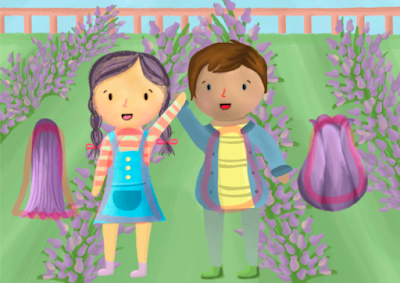
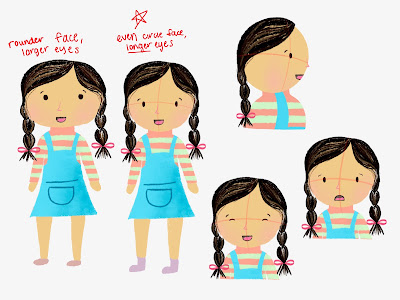
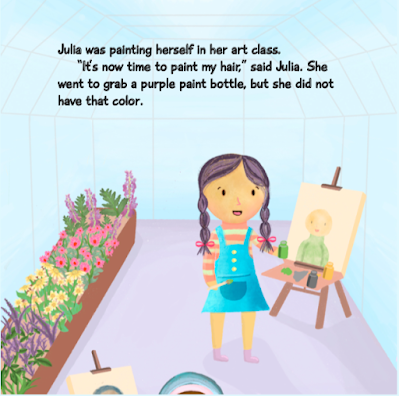
JJ: In “Just Like Flowers,” Julia paints herself in her art class, and when she discovers no one has purple paint, she becomes upset about her unusual purple hair. When I first conducted character study on Julia, she actually had brown hair, like most Asian American girls!


Image Credit: Jenny Jiang

After peer feedback, I implemented an amazing idea to give her an unusual yet memorable feature: purple hair. This unnatural color for her hair helps draw attention to kids.

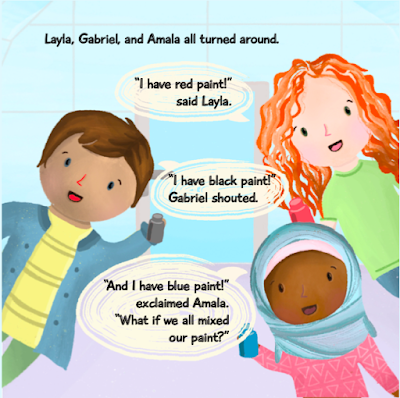
After Julia becomes frustrated with the lack of purple paint, her teacher explains the flower metaphor. Originally, I planned for the narrative to end after the metaphor, but then I wanted to tie the story back to the original painting scene. I developed the idea of mixing her friends’ paint bottles together to make purple paint.


Image Credit: Jenny Jiang

This end scene helped tie the entire book together. When I asked one kid her favorite part of the book, she said it was when Julia got purple paint to paint her hair. When I do storytimes, I ask the kids to guess how Julia finishes her painting, and I get super excited when they guess it correctly!

DP: What a great example of how peer feedback and incremental revision can really bring out the heart of a story.

Were there any specific resources you utilized (for example, software, reference books, online classes or tools, etc.) that were most helpful to you along the way?

JJ: I looked at many examples of published children’s books to understand their plot structure, sentence phrasing, and illustrations. This process helped immensely. I learned that there’s no right way to make a picture book after I saw a lot of the books varied in text and story complexity. This experience was transformative because I approached all these children’s books with a more mature, nuanced, and artistic perspective than when I was younger, and I found that whenever I go to bookstores now, I look at picture books differently than before I became a children’s book author.

As for the actual creation process, I used Procreate on my iPad with my Apple Pencil to illustrate. Procreate is really intuitive to use, and it helped me produce amazing artwork! I used Adobe inDesign to add the book’s typography.

Image Provided by Jenny Jiang (taken April, 2021)

DP: Thanks for sharing these helping details.  

Your bio indicates that one of the things you enjoy is working with kids. Based on what you've said above, it sounds like you've had the opportunity to share your book directly with young readers. Can you share more about what that experience has been like for you?

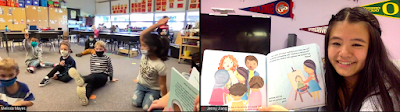
JJ: Of course! I have done author visits to pre-school and elementary school classrooms, and I discovered that doing read-alouds is my favorite part of this entire process. I can feel the contagiousness of the kids’ excitement as their eyes glue to the pages and raise their hands. When I visited my own first grade teacher’s classroom (after 10+ years!), I felt so happy to educate the future generation of society this important message while illuminating children of color. I am eager to continue reading my book to young kids and directly see my book’s impact to foster enthusiasm.


Images Provided by Jenny Jiang

DP: That's great, Jenny. I'll bet your first grade teacher was delighted to welcome you back to their classroom! And I couldn't agree more--reading your own book directly to kids is one of the most fantastic aspects of being an author. 

It’s my understanding that you are currently a senior in high school. Do your future plans include writing/illustrating more children’s books and/or further pursuing your general interests in digital art, creative writing, storytelling, and/or working with kids?

JJ: Yes, I’m a senior in high school! In the future, I would love to continue creating children’s books! I’m more invested in the illustration process, so I’d love to illustrate future children’s books, possibly with traditional publishers.

When I’m in college, I plan to continue volunteering with kids because I love their energy and vitality. After each read aloud session, I always step out of the room happier than how I came in. One child who read my book was super star-struck to learn that the picture book was published by a high schooler. It’s fulfilling how I’m able to serve as a role model to young kids.

Image provided by Jenny Jiang

DP: You are an excellent role model, indeed! 

If you're not already a member of SCBWI, and/or Willamette Writers/Young Willamette Writers, I encourage you to give these organizations a look as you seek to further your goals related to traditional publication (both have networks targeted directly to students.) 

JJ: That's so cool! I'll definitely check those organizations out."

DP: In your Amazon listing you indicate that those who purchase JUST LIKE FLOWERS are "taking one small step to promote diversity in children’s books!” Have you engaged in any book promotion and/or marketing activities that have been especially effective in terms of growing book sales?

JJ: As a self-published children’s book author and illustrator, I’ve handled a lot of the marketing. So far, I’ve sold 150+ copies of the book. I find that marketing on community sites helps a lot, as many members of the community love to support local authors, especially high schoolers. I’ve also reached out to elementary schools, where I read aloud my book to educate multiple kids at once. My book is also in local community libraries for kids to check out. My goal is to make my book well-familiarized with the Portland community, and then I will continue sharing my book to those outside my local area.

DP: Sounds like an excellent strategy!  

If you could go back in time, what would you tell your pre-published self? Or, said another way, what do you know now, that you wished you would have known a bit earlier and/or are there any lessons you've learned along the way that could help others who would likewise like to write, illustrate and self-publish a children’s book?

JJ: This is a really great question! I would tell my past self to continue working, despite the amount of work that the book may seem like it requires at times. Frequently, I had late night sessions where I spent hours illustrating but felt like I didn’t get any work done. My brain also filled with doubt that if some adults weren’t able to self-publish a children’s book, what can a high schooler do? There were many times when I was close to giving up, but I remembered my original mission and the smiles of the children of color, so I kept on illustrating. The work at the end is really worth it, as I get to see all the children enjoying your book! Another lesson I would tell myself and to all potential children’s book authors is to not let anyone get in the way. When I first expressed interest in this project, a few family members weren’t supportive, hesitant that the book would fail to get sales. While their discouragement did make me hesitate for a couple of days, I still decided to embark on the project to help children of color see themselves in books. Now that I’m in the marketing phase of my book, I feel proud that my book proved my original discouragement wrong and has surpassed over 150 sales.

DP: This is such excellent advice, Jenny, for creative folks in all ages and stages of their careers. I'm sure your experience is going to inspire many other prospective authors and illustrators to keep working on their creative projects to bring their goals to fruition. 

Is there something you wish someone would ask you about your path to publication for JUST LIKE FLOWERS that you haven’t had the opportunity to share yet?

JJ: A fun thing to learn about my book is that some of the illustrations were implicitly illustrated based on REAL elements of my life.

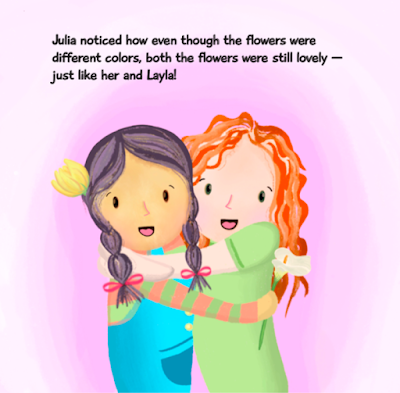
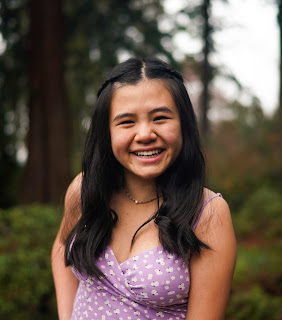
Here is an example of one page where Julia and her friend hug, which is eerily similar to one of my favorite photos of me and my friend hugging. This was unintentional, and I immediately showed my friend after I made this connection.


Images provided by Jenny Jiang

The flower box, which appears in many of the pages’ backgrounds, is inspired by a planter box in my neighborhood!


Images Provided by Jenny Jiang

I love how I was able to integrate little snippets of my life into my children’s book.

DP: I love all the little behind-the-scenes details you've shared! 

And thank you so much for sharing your Birth Story for JUST LIKE FLOWERS with us, Jenny. I wish you much success with this project!

JJ: Thank you so much for giving me this platform to share my story! I hope I was able to inspire future children’s book authors and illustrators!

DP: I have no doubt that you have, indeed! 

Dear readers, if you have been inspired by Jenny's story, please consider adding her book, JUST LIKE FLOWERS to your personal collection. You can find it here. Can't add another book to your own collection? Ask your local library to include it in their collection and/or share this post with a friend. 

 **********

Jenny Jiang is a senior at Sunset High School in Portland, Oregon and she loves creative writing, illustrating, storytelling, and spending time with kids! Jenny is passionate about Asian American representation in literature, and her debut children’s book JUST LIKE FLOWERS takes one step to promote diversity in children’s literature. Jenny is looking to study Business Administration during undergrad, specifically concentrating in marketing. Outside of school, Jenny loves to perform in Speech and Debate, where she continues to spread stories advocating for Asian American social issues. 


**********

Birth Stories for Books is an occasional feature of Dawn Babb Prochovnic's blog. Dawn is the author of multiple picture books including, Lucy's Blooms, Where Does a Cowgirl Go Potty?, Where Does a Pirate Go Potty?, and 16 books in the Story Time With Signs & Rhymes series. Dawn is a contributing author to the award-winning book, Oregon Reads Aloud, and a frequent presenter at schools, libraries, and educational conferences. Contact Dawn using the form at the left, or learn more at www.dawnprochovnic.com.  

December 30, 2021

2021 Year-End Post and Holiday Greeting

It's that time of year when we reflect on the past, intentionally connect with others, and make plans for the future. One of the ways I reflect and connect is through the tradition of preparing and mailing holiday greeting cards.

Each year I page through my (old-style) calendar and make note of the highlights and ordinary happenings in our household. I approach this task as an opportunity for creative expression, aiming to convey our family news in a way that also reflects the current trends, events, and/or themes in our world. 

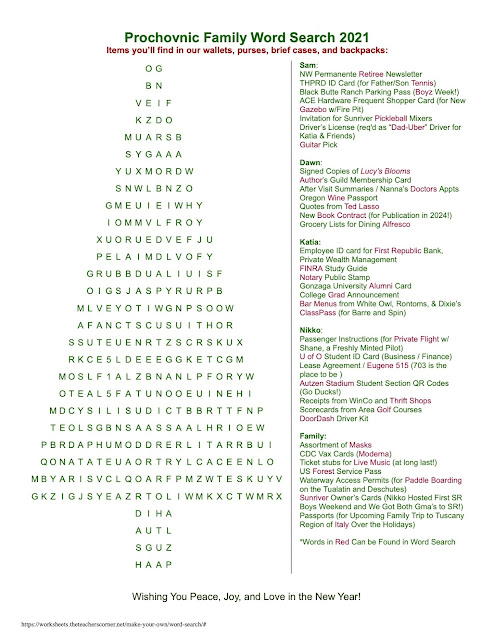
This year I chose a word search format to share our family updates, using a tool available at https://worksheets.theteacherscorner.net/make-your-own/word-search/# (which, incidentally, is a great resource for educators): 

Although the word search format is not as clearly indicative of the year's theme as the past few have been (2020, 2019, and 2018), I do think that words have been a key aspect of the past year: the words we use to communicate with each other; the words that have newly entered our casual conversations (i.e. vaccines, masks, Moderna); the words we pay attention to; the words we ignore; the words we welcome; the words we shun; and the importance of discerning words that are true and words that are untrue in an era when words are deliberately weaponized for self gain.  

Words are powerful. They can be used to love. They can be used to hate. They can be used to help. They can be used to hurt. They can be amplified. They can be silenced. They can inform, and they can misinform.  

Words are the raw material that I work with as an author, and as a picture book author in particular, I spend my writing time searching for just-right words for each and every sentence in each and every story I write. 

This year's annual greeting captures some of the words that are reflective of my family's 2021 story. I look forward to experiencing, writing, and sharing new stories with the people I love in the coming year.  May you do the same. And may words such as Peace, Joy, and Love find their way into our lives and into our world in the New Year. 

Katia, Sam, Dawn, and Nikko, 2021


November 15, 2021

World Toilet Day Resource Roundup

When my potty-humor books (Where Does a Cowgirl Go Potty? and Where Does a Pirate Go Potty? ) first rolled onto the scene, I found myself wondering aloud about the appropriateness of creating silly books during such a serious time in our world. I confessed about my worry that maybe I should use my gifts for more serious subjects. 

Photo Credit: West Margin Press

In the end, I came to the conclusion that it is not an either-or situation. That there is in fact value in light-hearted books, and also, that there are ways to connect silly topics to more serious issues. So, although I do try to laugh and have fun, I also do my best to use my platform to raise awareness about topics of import, for example, the importance of clean water and sanitation.

One way to connect this topic to my silly books is to raise awareness about World Toilet Day, a serious observance that takes place on November 19th each year to inspire "action to tackle the global sanitation crisis and help achieve Sustainable Development Goal (SDG) 6, which promises sanitation for all by 2030. Established by the World Toilet Organization in 2001, World Toilet Day was made an official UN day in 2013." (Source: World Toilet Day Website).

The theme of World Toilet Day 2021 is, "Valuing Toilets." 

Source: World Toilet Day website

Visit the World Toilet Day website where you will find fact sheets to help better understand the issue, along with social media resources to help draw attention to the issue and opportunities to join the conversation and take action. 

For those looking for even more resources, such as learning extensions and enrichment materials for young readers, here is a solid rundown:  

*Water1st International supports sustainable clean water projects and toilets for the world's poorest communities. They also provide helpful curriculum guides and information about clubs and other youth leadership opportunities related to this issue on their website.

*Northeast Ohio Sewer District offers a seven-part educational series that can be accessed via YouTube.

*The state of New Jersey has educational program called Clean Water Raingers, with interactive activities that can be accessed on their website. 

*Marshall Mitchell, the artist behind the song that accompanies the book trailer for Where Does a Cowgirl Go Potty?, wrote an entire CD of watershed songs for the Illinois River Watershed Partnership. 

*Annie Lynn, of AnnieBirdd Music, LLC is a vocal advocate for our planet, and she writes and produces a variety of music for use in educational settings, and she regularly shares a variety of educational resources via Twitter. Here is one example of a song that Annie has developed with interactive elements to engage students in conversations and advocacy around climate issues. (Incidentally, Annie Lynn / AnnieBirdd Music, LLC is the artist behind the song that accompanies the book trailer for Where Does a Pirate Go Potty?)

*Educators' Guides for Where Does a Pirate Go Potty? and Where Does a Cowgirl Go Potty? go well beyond the silly potty humor portrayed in the books. The guides provide pre and post-reading discussion questions along with learning extensions that support science, math, and language arts, as well as interactive activities such as word searches and Reader's Theatre scripts.  

I'm bolstered by my firm belief that igniting a child's desire to read is serious business, and I'm hopeful that my silly books (and the many fun resources I've developed and curated to support these silly books) will bring laughter into lap time and snickers into story time, setting a joyful foundation for a lifetime of reading. (And, if you ever need a little toilet flushing sound loop to flood you with laughter, you'll find one here. Enjoy!)

Photo Credit: Dawn Prochovnic

November 10, 2021

Birth Stories for Books: Who Is a Scientist? by Laura Gehl

Hello readers! Up next is another Birth Stories for Books interview. Today's guest, Laura Gehl, shares some unique insights about her path to publication for one of her latest books, WHO IS A SCIENTIST?, so let's get right to it. 


Dawn Prochovnic: I’m so glad to have you on the blog, Laura, and I’m excited to learn more about your latest book, WHO IS A SCIENTIST? (Millbrook Press, October 2021.) 

Laura Gehl: Thanks so much for having me, Dawn! 

DP: In recent interviews on Mr. Schu Reads and the Lerner Books websites, you’ve talked about what inspired you to write this book. I’d love to hear more about the process and timeframe between your initial idea for the book and the manuscript that was formulated fully enough to submit to an editor. For example, the book features a very diverse range of scientists. How did you connect with these individuals, and how did you arrange for the excellent collection of photographs in the book that features snapshots of the scientists’ professional lives and personal hobbies?

LG: Great question! I had a few scientists in mind when I started working on the project. To find more, I posted on social media, talking about my vision and goals for the book. Some scientists volunteered themselves after reading my post, while others were referred to me by friends who thought they would be a great fit. Then I needed to find photographers…in many different locations…to take the photos! One of the photographers was someone I knew personally, and one was a referral from an old friend. The others I found through online searches for photographers in each of the cities where the scientists lived. It was actually a LOT of work to find all the photographers, connect them with the scientists, arrange for permission forms and payments, etc…not to mention that we were dealing with COVID. And one scientist moved to Australia before we got her photos taken! But the hard work paid off. The photos of each scientist at work and at play are the heart of the book, and I am thrilled with how they turned out. 

DP: The photos are an excellent aspect of the book! It's fun to hear how they came to be. 

When you compare one of your earliest manuscript drafts to the published book, what stands out for you in terms of what is most different? Likewise, is there anything in particular that stands out that was included in your earliest drafts and survived the revision process?

LG: The biggest thing that stayed the same was the primary text (Who is a scientist? This is a scientist. Isha is a meteorologist.) And on the flip side, the biggest change was the addition of the secondary text, giving more information about each scientist’s work. 


DP: In addition to the primary and secondary text, I love the many “extras” in this book. The "Meet the scientists” QR code that takes you to a video where the scientists introduce themselves. The name pronunciation guide in the back of the book. The flow chart that helps a reader decide what branches of science they might most enjoy exploring. 

Image from Who Is a Scientist? by Laura Gehl

DP: How did those extras come to be? Were these elements included in your initial vision for the project, or did they develop in collaboration with your publisher’s editorial team? 

LG: The back matter was very much a collaboration with my publisher. Millbrook is amazing with back matter, and I’m so grateful I got to work with Carol Hinz and Jordyn Taylor, among others, on the special back matter for this book. 

DP: Sounds like you had a great team to work with! 

Reflecting on the journey from idea to published book, is there any one moment along the way that you credit with opening the door for this particular book to find its way to publication? 

LG: I think including photos in my proposal was probably key to the book being acquired. The photos in the proposal were just photos I took from the Internet—not the photos that we ended up using in the book. But they gave my editor a sense of what I wanted to do with the book in a way that would have been very difficult to accomplish using only words. 

DP: It appears like your approach was really effective.

Shifting gears a bit, one of my favorite parts of being an author is connecting with young readers at school, library, and bookstore visits, and I’m always looking for new pro tips. Your bio indicates you are a former reading teacher, and your website indicates you do author visits, so you have experience on both sides of the table. Based on this experience, what professional advice or suggestions do you have for fellow author/presenters in terms of planning successful (in-person and/or virtual) events? 

LG: I think understanding the age group that you will be presenting to is key. If you haven’t spent time around 3-year-olds and you want to present to preschoolers, try to sit in on a library storytime or a preschool class before you put together your presentation. Same with 1st graders or 5th graders. What will work best for each age group is different. With 2-year-olds, for example, you really can’t ask a question and then have kids raise their hands to answer. If you call on a 2-year-old to answer a question, they will probably tell you that their cat’s name is Pluto or that they are wearing blue underwear. For the youngest kids, props, puppets, and songs work great (I like adapting a song they will already know, like Old McDonald or Twinkle Twinkle Little Star, to fit the book I am reading to them). For older kids, you can keep the same amount of interaction and humor but target it differently…with quizzes and games and group brainstorming exercises, for example.    

DP: Excellent tips, Laura.

I know from your social media accounts (and from our being in a book launch group together!) that you've had quite a year in terms of new releases, plus you offer freelance editing services, and you maintain an active schedule of virtual book events. How do you balance the time between your different book projects and the different aspects of the publishing business?

LG: I like doing lots of different things, because I never get bored, and if I am having trouble with one project, I can work on a different one. That said, I’ve learned that I sometimes need to say no even when I wish I could say yes. This fall, I’ve just been too busy to take on freelance editing projects, and I’ve had to turn down quite a few. My local SCBWI is doing a mentorship program right now that I would have loved to be a part of…but I knew I just didn’t have the bandwidth at the moment. It’s really hard for me to say no to anything writing-related, but sometimes it’s necessary, both in order to preserve my mental health and to preserve time to write! 

DP: If you could go back in time, what would you tell your pre-published self? Or, said another way, what do you know now, that you wished you would have known a bit earlier?

LG: I would tell myself to find a great critique group (or two) much sooner!  

DP: Is there something you wish someone would ask you about your path to publication for WHO IS A SCIENTIST?  that you haven’t had the opportunity to share yet? 

LG: I don’t think anyone has asked if I sold this book as a proposal or as a completed manuscript. The answer is that I sold it as a proposal… but I did include the basic text for the manuscript in the proposal. I didn’t recruit the actual scientists or the photographers until after I sold the book, but I had “placeholder” scientists and placeholder photos in my proposal to show how the finished book would look.   

DP: It sounds like that approach really helped the publishing team envision what you had in mind.

Do you have anything you’d like to tell us about what you’re currently working on? 

LG: Right now I’m working on another project with the fabulous team at Millbrook, a book about climate change, which will release in 2023 in time for Earth Day. I am learning so much every day I work on this book! (And for your readers who are considering how to sell a NF book idea, I sold this new book on proposal with sample text included, similar to Who Is a Scientist?)

DP: Thanks so much for sharing your Birth Story for WHO IS A SCIENTIST? with us, Laura. I've learned so much!

LG: Thanks again for hosting me, Dawn! 

Friends, the best way to thank an author whose insights have been helpful and/or intriguing to you is to support their work. Buy their books. Request them from your library. Read and share them with others.   

**********

Laura Gehl is the award-winning author of more than two dozen picture books, board books, and early readers including One Big Pair of Underwear; My Pillow Keeps Moving; Always Looking Up: Nancy Grace Roman, Astronomer; Except When They Don’t; and Odd Beasts. Laura lives in Chevy Chase, Maryland, with her husband and four children. Visit her online at www.lauragehl.com and follow her @AuthorLauraGehl on Twitter and Instagram. 


**********

Birth Stories for Books is an occasional feature of Dawn Babb Prochovnic's blog. Dawn is the author of multiple picture books including, Lucy's Blooms, Where Does a Cowgirl Go Potty?, Where Does a Pirate Go Potty?, and 16 books in the Story Time With Signs & Rhymes series. Dawn is a contributing author to the award-winning book, Oregon Reads Aloud, and a frequent presenter at schools, libraries, and educational conferences. Contact Dawn using the form at the left, or learn more at www.dawnprochovnic.com.  


November 3, 2021

Birth Stories for Books: MOONSONG, by Denise Gallagher

Hello, readers! I'm delighted to bring you another Birth Stories for Books interview--this time from an author/illustrator's perspective! Today's guest, Denise Gallagher, stops by to share her path to publication experience for her latest book, MOONSONG (Little Press Publishing.)

Book Cover by Denise Gallagher

Dawn Prochovnic: Welcome to the blog, Denise. Turning the pages in your book, I feel transported to a magical place and time. Even children who are not yet independent readers will enjoy the vivid images and the imaginative journey. I’d love to hear how the idea for this story came to be.

Denise Gallagher: Before I was an author and illustrator, I was a graphic designer with an itch to do more. Illustrating picture books was vastly different from anything I’d done before. I had a lot to learn! I felt that one way to do this was to write a picture book myself in order to practice illustrating one. I was drawn to folk tales and fairy tales and read them voraciously. I studied works from the Brothers Grimm to Aesop’s Fables. I loved the magic elements and vivid worlds contained in the stories. I then sat down with a sketchbook and a pencil and sketched and scribbled. 

Sketch by Denise Gallagher

My own magic spilled out onto the pages. What emerged was a very wordy book called “Claire de Loup” about a girl and a wolf in a forest. That was eleven years ago. That initial manuscript and the illustrations that accompanied it went through many iterations to eventually become what is now “Moonsong.” 

DP: Wow, that is quite a journey! What an inspiration you are for sticking with this story idea and seeing it through to fruition! 

I’d like to hear more about the process between your initial idea and the story that was formulated fully enough to submit to an editor.

DG: Over those eleven years, the manuscript that eventually became “Moonsong” changed many times. During that time, I joined the Society of Children’s Book Authors and Illustrators (a big first step to becoming an author) and attended conferences and critique groups. I took every critique and piece of constructive advice seriously. I listened and I revised. (First revision? It was WAY too long!) But I was always true to myself and to my story. 

My illustration style also changed during that time and I did a scary thing — I scrapped the entire book and illustrations and started over. 


Art Credit: Denise Gallagher

Art Credit: Denise Gallagher

I worked with an agent and got feedback on the new art and manuscript, but never an offer to publish. There were times when I was dejected and set the story aside. Then, in 2019 I attended a workshop where I got this bit of advice: “If something is not working with your story, try changing an aspect of it. Maybe the character, the voice, the setting?”  I took that advice to heart. I decided that my story might work better as a girl with a TIGER in the JUNGLE. I revised the manuscript and worked on a third round of illustrations. 

Early Sketch of Fulki a character in Moonsong, by Denise Gallagher

Illustration from Moonsong, by Denise Gallagher

Illustration from Moonsong, by Denise Gallagher

I changed the name to “Moonsong” and was excited about my story once more. It was then that I met my editor who loved the story and the art. It took nine months to complete the illustration and layout of the book and now it is in the hands of readers and I am ready to celebrate!


DP: Congratulations! It's time to celebrate, indeed.

It sounds like you definitely made some major revisions to your story along the way to the path of publication. When you compare one of your earliest drafts of this story to the version in the published book, what stands out for you in terms of what is most different? Likewise, is there anything in particular that stands out that was included in your earliest drafts and survived the revision process?

DG: The original story did not include the missing moon! Looking back now, I realize that including the problem of the missing moon in the plot helped Fulki and the Tiger grow together as friends and added another layer to the tale.

I love playing with language. I’m happy to say that a lot of the initial phrases that I loved survived to the end, even as the manuscript was whittled down. The song lyrics changed, the setting changed, but in the end, Fulki and the Tiger still “tumbled and danced and shared stories and cakes.” 

DP: Thanks for sharing those details, Denise. 

Reflecting on the journey from idea to published book, is there any one moment along the way that you credit with opening the door for this particular story to find its way to publication? 

DG: I have to say, sometimes it helps to set something aside for a bit and return to it later with fresh eyes. With “Moonsong” it took hearing that bit of advice about shaking the story up for me to really dig in and come up with a fresh, modern story that maintained the vivid, magic folk tale feel that I loved.

DP: Well said, and an important reminder. 

In addition to authoring and illustrating books, you also have a passion for design. How do you balance the demands of these different elements of your creative life? 

DG: I received my degree in graphic design and I still really enjoy it. It’s a different skill set — designing projects from logos to packaging. Happily, these graphic design skills also come in handy when working on books. I’ve been fortunate to assist with designing each of them. I truly love great type and compelling page layouts, eye-catching color palettes and unique details. Using these elements along with my writing and illustrations to create a book that I am proud of is truly a joy. So, I consider myself lucky to be able to have these skills. Writing, illustration, graphic design — they are all ways that I can share my stories and express myself creatively.   

DP: Are there ways these different elements of your creative life work in concert with one another? For example, the lettering on the cover of MOONSONG draws the reader in and sets the tone for the book. I’m guessing that’s no accident.

DG: Book design is an art all on its own. I approach each of my book projects as a whole – from the art and words to the design, color and type. So yes! I designed the cover of “Moonsong” as an invitation to the reader. I wanted to create a sense of wonder and draw them in before they even began to read.

DP: I definitely feel the sense of invitation when I look at the cover!

DG: I also believe that books are a child’s first introduction to art and literature. So I try my best to create art and stories that will delight and engage them — helping them to see the beauty that exists in the world all around them. 

DP: It really shows that you approach your books in this way. 

If you could go back in time, what would you tell your pre-published self? Or, said another way, what do you know now, that you wished you would have known a bit earlier?

DG: I’d definitely tell my younger self that it is true, “Patience is a virtue!” There is a lot of waiting in publishing. Often that’s a good thing. I know now that I was not quite ready to be published when I had just graduated from college, or even when I started to focus on publishing again many years later. It took a lot of hard work, a lot of learning, a lot of starting over and a lot of patience. But now? Now comes the fun part. After all of my time preparing, I can now share my work with children and families, teachers and librarians. Now I can talk about my progress and my love of art and literature and I can sing the Moonsong. Even though my singing is a little off-key!

DP: Is there something you wish someone would ask you about your path to publication for MOONSONG that you haven’t had the opportunity to share yet? 

DG: I’ve only shared this little tidbit with one other group but I’ll share it with you, too. I’ve included a secret “Easter egg” in “Moonsong.” If you look carefully at the illustration where the children are being fussed at for singing, Fulki is holding a book. Hidden on the spine of the book are the initials W.B. and on the cover is the face of a tiger. W.B. stands for William Blake, an artist and poet from the 1800s who wrote one of my favorite poems “The Tyger.” In that scene, Fulki is reading William Blake’s poem and smiling. I like to believe that she is thinking of the Tiger who is waiting to sing the Moonsong with her in the jungle. 

DP: I love learning and discovering little secrets like this! 

Do you have anything you’d like to tell us about what you’re currently working on?

DG: I am excited to report that I have written a middle school novel. I’m still working on revising and editing, but it’s in its final stages. And when it is complete, it will contain illustrations throughout.


DP: That sounds fantastic!

DG: When I started this literary journey, I dared to believe that I’d even be able to write and publish a picture book. When the idea for my novel started nagging at the edges of my brain, I was not sure I could do it. But here we are, 40,000 words and a dancing bear later, ready for my next chapter.

DP: That's fabulous, Denise. Thank you for sharing your experiences and insights with us. 

Friends, I hope you will head on over to Bookshop or your favorite local indie and get yourself a copy of this beautiful book. It's available everywhere books are sold. You can also ask your local library to include it in their collection and/or share this post with a friend. 

**********

Denise Gallagher is an author and illustrator for children. As a child, she drew constantly. Now, she can usually be found deep in thought with a sketchbook and a cup of tea. She loves folklore, music and nature and draws inspiration from her lush, green Louisiana home. The combination of her lyrical writing and her whimsical artwork has charmed children of all ages. She has written and illustrated picture books, is currently working on a middle grade novel and has also illustrated folk tales from both Louisiana and Canada. Denise is devoted to promoting a love of arts and literature in both children and adults and nothing pleases her more than to share her stories with you. Learn more at denisegallagher.com.


**********

Birth Stories for Books is an occasional feature of Dawn Babb Prochovnic's blog. Dawn is the author of multiple picture books including, Lucy's Blooms, Where Does a Cowgirl Go Potty?, Where Does a Pirate Go Potty?, and 16 books in the Story Time With Signs & Rhymes series. Dawn is a contributing author to the award-winning book, Oregon Reads Aloud, and a frequent presenter at schools, libraries, and educational conferences. Contact Dawn using the form at the left, or learn more at www.dawnprochovnic.com.