June 8, 2022

Birth Stories for Books: A FAMILY LOOKS LIKE LOVE, by Kaitlyn Wells

Here comes a treat, readers! 

I recently had the opportunity to interview Kaitlyn Wells about her debut picture book, A FAMILY LOOKS LIKE LOVE, (illustrated by Sawyer Cloud, Penguin Random House/Flamingo Books, May 31, 2022). Today, I get to share that interview with you.

by Kaitlyn Wells and Sawyer Cloud

Dawn Prochovnic: Welcome to the blog, Kaitlyn. I’m looking forward to learning more about the path to publication for your debut picture book, A FAMILY LOOKS LIKE LOVE. 

In an earlier interview you shared that the inspiration for this book was based on heartbreaking experiences you had growing up as a biracial child. I wonder if you could share more specifically how and when the idea came to you to write about these experiences in the form of a children’s book featuring a young pup who looks different from her doggy siblings? 

Kaitlyn Wells: Honestly, reliving a painful childhood experience wasn't the first thing I wanted to write about, but friend and fellow author Nancy Redd reminded me that it's OK to put yourself into your art and tell empowering stories. I thought about what I want other people to know about what it felt like to be told you didn't belong and that your family wasn't your own, simply because of the color of your skin. Along the way, I remembered that my dog Sutton looks completely different from her own family, too. She's a Chihuahua-mix with a brown tricolor coat. Two of her siblings have scruffy blond coats, and another has a black tricolor coat. Sutton's also a dog who sees the best in everyone and loves you no matter what you look like. It just seemed like telling a difficult story with my dog as the conduit fit perfectly with what I was trying to do, and made it a little bit easier to write the story too.

Interior Image from A Family Looks Like Love

DP: It's so nice to have the backstory, Kaitlyn. Thanks for sharing it with us.

In addition to writing (and reading!) books for kids, you are an award-winning journalist, and you’ve written for a long list of different publications. This suggests you have quite a bit of experience submitting ideas to editors, and yet the children’s book publishing industry can pose its own unique challenges. I’d like to hear about the process and timeframe between your initial idea for this book and the manuscript that was formulated fully enough to submit to an editor. 

KW: Looking back, I've been writing stories since middle school. I've been honing my craft—as a writer, journalist, author or whatever you want to call me—my entire career. With this particular manuscript, I began scribbling down thoughts for the book in August 2019. But because of a mix of perfectionism and imposter syndrome, I didn't write my first draft until December 2019. From there, I went through several revisions with my critique partner. That same partner and friend shared my manuscript with her agent to ask for advice on what I should do next. Then things took a surprising turn. The agent, Jane Startz fell in love with the manuscript and offered to represent me. I did my research, we had a great conversation, and I signed with her that following May. After a few more revisions we went on submission. At that point, it became emotionally draining with every "no" we received from editors and publishing houses. My story was an #ownvoices manuscript, so it felt like every rejection was a reminder that my voice, that my lived experience, wasn't good enough for the publishing world. One day, I finally received good news, and in September 2020 I accepted an offer with Penguin Random House/Philomel Books (currently under Flamingo Books). Now, you'll be able to find A FAMILY LOOKS LIKE LOVE in bookstores on May 31, 2022! 

DP: That's quite a path-to-publication, story, Kaitlyn! Hooray! 

KW: Thank you! Looking back, I'm still surprised by how fast the process went and I believe my book publishing journey isn't typical. Although, just saying that out loud, I'm reminded that I don't have to justify my journey and I need to push imposter syndrome aside (yet again). So, correction: I didn't luck into anything during the process. I worked incredibly hard and earned everything I have achieved.

DP: Indeed! 

Reflecting on the journey from idea to published book, is there any one moment along the way that you credit with opening the door for A FAMILY LOOKS LIKE LOVE to find its way to publication? I’d also like to hear if there is anything in particular that you bring from your other research and writing experiences that helps you be more successful in your role as a children’s book author?

KW: All of the credit in the world goes to my colleague, Nancy Redd, who believed in me. Well, I should say my mother is the one who's always believed in me, followed by my wonderful husband. But in this particular instance, it was Redd who pushed me to write this particular picture book at this moment in time, and opened another door by sharing the manuscript with her agent. I will also say that our meeting was an accidental encounter. Redd and I live on opposite coasts in the U.S., and we only know one another because one day I shared a job opening at my company and she replied to the posting. I helped her through the application process by offering her cover letter and interview help, and when she landed the job our friendship grew. This is just to say that you never know what connections you make today will lead to good fortune in the future. So do the networking, be kind to everyone you meet, and put yourself out there.

DP: That's great advice, Kaitlyn, and such an excellent example of this advice in action. 

KW: I think so, too. As for the second part of your question, I'm a firm believer that skills are transferable—you've just got to know how to apply them to each new situation. I bring everything into my kidlit journey. The research and reporting skills and ability to translate complex information into compelling narratives translates well into my work as a children's book author. 

DP: What an inspiring and empowering perspective. 

When you compare one of your earliest drafts of this story to the version in the published book, what stands out for you in terms of what is most different? Likewise, is there anything that stands out that was included in your earliest drafts and survived the revision process?

KW: The first version of the story featured a not-so-friendly squirrel. I don't want to spoil the story, but that character was later replaced with a honey bee who says some "stinging" things to my main character, Sutton. 

DP: Ha! It will be fun for readers to discover this revision! 

KW: And since looks are integral to this story, I also considered the coat colors and textures of the dogs. The original version described Sutton's family as cream-colored or white (a nod to some of my own family members). But during the revision process, it became clearer to me that the story was centering whiteness, which wasn't something I wanted to do. The dogs ended up having yellow and brown coats instead, and I like this version better because it reflects the coats of the real-life Sutton's siblings.

Interior Image from A Family Looks Like Love

DP: This is an excellent example of how important the revision process is to the writing process. 

You write on a wide range of topics and for a variety of different publications in your role as a journalist. You also publish a newsletter "that explores how Black, Indigenous, and womxn of color navigate the world,” and you are engaged in many activities and initiatives, such as volunteering for organizations like the ASPCA and standing up for banned books. How do you balance the time between your different writing projects and the different aspects of the book publishing business alongside an active personal life?

KW: Oh goodness, I am nowhere near on top of my game. For example, I will admit my newsletter isn't as active as I would like it to be. That's all to say that my work-life balance often has its struggles. But honestly, I love being busy and learning and growing as a person. I love helping others, especially animals, and if I can do something to make the world a tiny bit better, then I'm going to try. 

When it comes to finding that balance, I constantly remind myself that perfection doesn't exist, and just doing the thing is better than doing nothing at all. In general, I try to devote an hour or two to each major project with the understanding that I can always come back to it and improve upon it another day. And if I don't that's OK too because I made enough progress that allows me to check it off my to-do list. No matter what, I try to remain in the moment and find joy in the task at hand so I don't obsess about it later on. Otherwise, I think self-tormenting can detract from my entire point of creating and growing and learning and helping others. It's a constant battle, and I'm always working on finding that balance.

DP: Thanks for the healthy and helpful perspective, Kaitlyn.  I'm grateful for the reminder that we are all a work-in-progress. 

If you could go back in time, what would you tell your pre-published self? Or, said another way, what do you know now, that you wished you would have known a bit earlier?

KW: If I could go back to my childhood self who loved drawing horses and fairies, I would tell her to keep at it. I desperately wish I had developed my illustrator skills as there's a lot more freedom to tell stories a certain way when you have a strong say on both the words and images associated with your books. Then I would tell my adult self to just get the words out on the page. They don't need to be perfect because they can always be improved upon later. Just write it down. Come back to it later. Also, don't be afraid to write more stories than you think people want to read because, honestly, the world can always use empowering tales by a strong, Black biracial woman. Lastly, I would tell both selves that you deserve to be here, and don't let anyone tell you otherwise.

DP: Yes, to all of this. 

Is there something you wish someone would ask you about your path to publication for A FAMILY LOOKS LIKE LOVE that you haven’t had the opportunity to share yet? 

KW: What I will say is that every child matters. Everyone deserves to be represented in the books that they read. Don't be afraid to push boundaries and stay true to the authentic stories that you want to tell. 

If someone tells you that your experiences as a diverse author don't have merit, surround yourself with people who respect you and your art. If someone actively keeps your story and the stories of your literary peers out of the hands of readers, know that you can do something about it. You can report book censorship to the American Library Association or the National Coalition Against Censorship, and run for local office to combat proposed censorship laws. 

DP: Thank you for this, Kaitlyn. I know some of our readers really needed to hear these words and receive these resource links today. 

Do you have anything you’d like to tell us about what you’re currently working on? 

KW: I have so many unpublished stories in the works. Right now, I'm excited about my upcoming biographical STEM picture book. I hope to announce it soon. I encourage you to subscribe to my newsletter for updates. (Shameless plug, I know.)

DP: Shameless plugs are welcome here! 

Thanks so much for sharing your Birth Story for A FAMILY LOOKS LIKE LOVE with us, Kaitlyn! 

KW: Thank you for inviting me to participate! And before I forget, you can always snag a signed copy of A FAMILY LOOKS LIKE LOVE with one of my local indies. Happy reading!

DP: Dear readers, you've heard me say it before: the best way to thank an author whose insights have been helpful and/or inspiring to you is to support their work. Buy their books. Request them from your library. Read and share them with others. A FAMILY LOOKS LIKE LOVE is available everywhere books are borrowed and sold, including your own local, indie bookstore. 

********** 

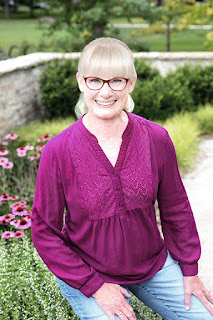
Image Credit: Sarah Kobos
Kaitlyn Wells (she/her) is an award-winning journalist whose work has been featured in The New York Times, The Wall Street Journal, and The Washington Post, among others. Her commentary on diverse literature can be found in The New York Times Book Review, BookPage, and Diverse Kids Books. Her debut picture book A Family Looks Like Love arrives May 31, 2022 with Penguin Random House/Flamingo Books. She lives in New York City with her wonderful husband, rambunctious dog, and demanding cat. Visit KaitWells.com to subscribe to her newsletter that explores how Black, Indigenous, and womxn of color navigate the world. And follow her on Facebook, Instagram, TikTok, and Twitter. 


**********

Birth Stories for Books is an occasional feature of Dawn Babb Prochovnic's blog. Dawn is the author of multiple picture books including, Lucy's Blooms, Where Does a Cowgirl Go Potty?, Where Does a Pirate Go Potty?, and 16 books in the Story Time With Signs & Rhymes series. Dawn is a contributing author to the award-winning book, Oregon Reads Aloud, and a frequent presenter at schools, libraries, and educational conferences. Contact Dawn using the form at the left, or learn more at www.dawnprochovnic.com.  

June 1, 2022

Birth Stories for Books: SOME DADDIES, by Carol Gordon Ekster

Hello readers! Today I have the pleasure of sharing with you an info-packed Birth Stories for Books interview with Carol Gordon Ekster, where we'll learn about the path to publication for her latest book, SOME DADDIES (illustrated by Javiera Maclean Alvarez, Beaming Books, May 2022.) 

Carol contributed a guest post about her book, YOU KNOW WHAT?, back in 2019, and I'm so happy she's able to return to share more of her perspective and experience with us. 

by Carol Gordon Ekster and Javiera Maclean Alvarez

Dawn Prochovnic: Welcome back to the blog, Carol. We first met when I hosted you for a guest post back in 2019 to share the Birth Story of your picture book, YOU KNOW WHAT? Since then we’ve chatted on Writers’ Rumpus when you interviewed me during the launch of my potty humor books, and we’ve stayed in touch via social media. It’s great when authors return to the blog for a visit, especially when it’s because they have a new book out! I’m so excited to hear more about the path to publication for your latest title, SOME DADDIES (illustrated by Javiera Maclean Alvarez, Beaming Books, May 2022.) The cover art is so inviting. I immediately wanted to open the book and see what was inside—and I was not disappointed! 

In an earlier interview, you shared that the inspiration for this book came out of a FaceTime conversation with your grandson. I wonder if you could recap some of that again for us here. I’d also like to hear more about the process and timeframe between your initial idea for the book and the first manuscript that was formulated fully enough to submit to an editor. 

Carol Gordon Ekster: Thanks for having me, Dawn! Yes, I was FaceTiming with my grandson on 12/17/17, when he was three years old. He noticed my husband had just shaved, and said his daddy shaved too, but his daddy had a beard…so he’s going to have a beard when he gets older because he’s going to be a daddy. I said…"Some daddies have beards…” I paused, my writing brain igniting, and wrote that down as a title. After drafting it and revising it, and bringing it to three of my critique groups, I thought it ready to send out. (It really wasn't!) I first sent it to an agent about three months later in March and heard the next day. He wrote, "It's very nice and there aren't enough father stories. What else do you have?" I sent a few other manuscripts, but never heard back from him. That's the nature of this business! He wasn't the right agent for me. I sent it to a few other places with limited responses, one agent saying it was too similar to Todd Parr's Daddy book, (which it isn't). 

DP: That is the nature of this business, indeed! 

You’ve mentioned that this book was “hearted" by Naomi Krueger at Beaming Books during a #PBPitch event on Twitter. Twitter pitch events are important opportunities for authors such as myself who are un-agented. Could you share with us the pitch for this book that caught your editor’s eye? 

CGE: On October 25, 2018, there was a #pbpitch event. Here was what I put on Twitter: "SOME DADDIES-a 351-wd concept PB with heart. Some dads gro beards, some tuck u in with a song, some r called Baba, Tatti, etc.Every daddy is different.This is a repeated refrain.The bk opens possibility 4 illus 2 sho differences- looks, ethnicity, family structure, etc. #PBpitch"

Naomi Krueger from Beaming Books "hearted" the pitch. I reread my manuscript and sent it right out. And exactly one year to the day that I first FaceTimed with my grandson, I saw the acceptance on Submittable. Now that's fast in the world of publishing! But because of Covid, it was delayed a year, and came out May 17, 2022. And now my grandson is seven! Making books takes time. And as creatives, we'd be happier if we just let it take the time it takes. I've also realized that this business is very subjective.

Before I got the contract, I received communication from Naomi: "I love this celebration of fathers and all the diverse personalities and attributes that dads can have. I've been looking for a book about dads, and so I'm really excited about your manuscript." So my pitch caught her attention because she was interested in the topic. And when I got my acceptance letter, I knew she was the perfect editor for me. "We are pleased to inform you that Beaming Books would like to acquire “Some Daddies” to be published in a future list season. We love how this book celebrates the diversity of what it can look like to be a dad. This is so important for young kids who are starting to notice other children’s parents and compare them to their own, as well as how they develop their perception of healthy masculinity. This is a joyful book with a serious message—the type of book we would be proud to publish at Beaming Books." It touched on why I wrote the book, so that kids would understand they are not alone. That we all realize at some point that our daddies are not perfect and are in some way different from other daddies, but we love them for who they are. 

Naomi went on maternity leave right after my acceptance, but I started to work on revising and tightening immediately. And then when she came back from her leave, we worked on it more together. She is an amazing editor. It was clear that she had a vision for this manuscript.

DP: What a fantastic backstory, Carol. I "heart" Beaming Books. How wonderful that you had just the right manuscript at just the right time for them! 

When you compare one of your earliest drafts of this story to the version in the published book, what stands out for you in terms of what is most different? 

CGE: What stands out to me is that I restructured it to have more of an arc, even though it's a concept book. I originally started with my initial idea – "Some daddies have beards." I revised to begin with the dads waking up and we go through their day and bedtime. I also initially had the different names for daddies in different languages, like Baba, Tatti, etc, as I had in my #pbpitch, but Naomi thought it best to leave that out as the book isn’t specifically about other cultures and languages. It’s more about personalities. Which was true! So now I've included that on my website as a follow-up activity. I do activities for each of my books in all modalities. 

And I discovered something humorous when looking through my drafts in response to this question. In the page about what dads drink, I didn't have this in my accepted manuscript, but I added in, "Others drink a bottle of beer." I did this because as a fourth-grade teacher I saw that kids worried about their dads having beers when the local policeman came to our class each year to talk about drugs and alcohol. I wanted to assure children that it is perfectly normal for parents to have beers sometimes…and that they are not alone in their concerns. But before I had even shown this to Naomi, I decided to delete that line. 

DP: What a great find in your draft file and such heartwarming reasoning to go behind it. 

On the flip side, is there anything that stands out that was included in your earliest drafts and survived the revision process?

CGE: Something that stands out that was included in my early drafts and survived the revision process was the sentiment in this page spread, 

"Some daddies share comforting words and cry with you.

Others love making you laugh. 

Some barely hug.

Others hug like bears." 

Interior Image: SOME DADDIES

Naomi was sensitive to children whose fathers are not involved in their lives or who have difficult relationships with their dads. I appreciated her wisdom and guidance to reword the first line to put it in a more positive light than my original wording and then to suggest setting it in a doctor's waiting room after one daddy made a mistake and missed catching his daughter resulting in a playground fall. 

This page was important to me as I think it really shows the different personalities dads can have. My dad was one who barely hugged. And when I was younger that was hard for me. But I learned to accept him and appreciate his many other incredible gifts.  

Interior Image: SOME DADDIES

DP: Oh, these details make me love the book even more, Carol. Thank you for sharing this with us. 

When you compare the path to publication for this book to the paths to publication for some of your other children’s books, what are some of the key similarities and differences in terms of the publication journeys for each?

CGE: A key difference was that this was acquired faster than my other manuscripts, but still took more than four years from the initial idea to holding the book in my hand. In my journey as an author, that's a quick turnaround. My next book comes out in 2023 and I wrote the first draft in 2013. That's ten years! The similarities are that each book acquisition has been a unique process, but always an exciting and nerve-wracking time. I know that it will really be out in the world so I want to make it my very best work. The pressure is real! I will share a manuscript with others even after it is acquired. And you realize what a group effort it is to make a book. I do not write alone. From the beginning, I get ideas and input from critique buddies, then from an editor, and the illustrator and art director, all who add their magic to make this into the amazing art form that picture books are. 

DP: That is so true! There are so many helpful hands that join together to make a children's book. 

Another magical part of being an author is connecting with young readers at school, library, and bookstore visits, and I’m always looking for new pro tips. In addition to being a children’s book author, you are a retired teacher who taught 4th grade for 35 years. (Wow!) Based on your wealth of experience working with young learners, what professional advice or suggestions do you have for fellow author/presenters in terms of planning successful (in-person and/or remote) book events?

CGE: First and foremost be passionate! Kids know when you are not sincere. You have to be vibrant and keep their attention and interest. You need to engage them. I ask the audience questions on a power point presentation and have them raise their hands to let me know which answer they choose. It definitely helps that I was a teacher. I know topics that were covered in my grade level and what teachers want you to focus on. And I love touching on the life lessons of perseverance, responsibility, and hard work. We have the power to touch lives! And I want to give one tip I see happen in auditoriums or smaller book events all the time. When you get questions from the audience, repeat that question. The others may not have heard it and it's hard for listeners to be engaged without knowing what the question was. 

DP: Great tips, Carol!

Taking a stroll through your website and social media feeds, it is clear you are a passionate educator at heart. You’ve said that writing picture books has allowed you a second career and a new way to communicate with children. If there is one overarching message you hope to communicate to children through your body of work, what would that message be? 

CGE: You are not alone! And there is a community of people and books that will help you navigate your way through life. 

DP: What a beautiful message! 

You are a member of multiple critique groups, and you have written over 100 manuscripts, several of which that have now become books. How have you created structure(s) in your life to keep you on track and moving forward despite the increased level of flexibility in your current schedule as compared to when you were a teacher and school bells rang to tell you when it was time for lunch or recess? I’d especially like to hear if there is anything in particular that you bring from your teaching career that helps you be more successful in your role as a children’s book author?

CGE: I have actually specifically NOT created structure in this author life. There was too much of that in my teaching life. Now I usually begin my day with exercise and then move on with the day as my mood dictates. Every day there might be something that moves me to action. An e-mail from a critique buddy with a critique that makes me want to jump into a revision using their notes. I might get a response from an agent or editor that pushes me to make a new submission or rethink one of my manuscripts. I might have an opportunity for promotion, like this interview! I might feel drawn to read one of the picture books in my pile that I've picked up from the library. And something in that book I read just might click on an idea for a new manuscript or a revision. If I have a deadline for something, I put a reminder on my phone or leave myself a note to make sure I take care of all the many facets of a writing life. But this is where I want to be, immersed in this wonderful calling. Too often I hold off on dealing with all the other responsibilities of life, preferring the meditative feel of lining up words in just the right order. 

DP: What a wonderful answer to this question, Carol. I so appreciate the validation for letting the writing life take you where it will take you.  

If you could go back in time, what would you tell your pre-published self? Or, said another way, what do you know now, that you wished you would have known a bit earlier?

CGE: It takes the time it takes. Be patient! And trust in the process. 


DP: Indeed!

Is there anything else you wanted to share about SOME DADDIES? 

CGE: My husband has helped me make book trailers for all but my first book, which was before I knew about trailers! But for SOME DADDIES, we mentioned the trailer to my creative jewelry-designing musically talented brother-in-law, Ron Rizzo, when we were staying at my sister's house. The next day we heard him strumming on his guitar and whistling. He wrote an original song for the trailer! My husband used that song to organize Javiera's illustrations and I just love the result of this family project. Here's the link. 

DP: Oh my gosh, Carol! I LOVE this song and book trailer so much! As you may recall, I've added musical elements to several of my picture books, and this song and video of yours is such a GREAT example of how music can add so much enrichment to an already marvelous story. Bravo to all involved!

Shifting gears, do you have anything you’d like to tell us about that you’re currently working on?

CGE: I'm still always working on multiple manuscripts at once and when so moved, go back to older manuscripts that have not yet sold. But I'm very excited about the next upcoming picture book, Trucker Kid, illustrated by Russ Cox, coming out spring 2023 with Capstone. This is one of those manuscripts that I believed in and kept revising and then pulled it out again during Covid because I felt more appreciative than ever of the importance of trucking in our lives. I added an author's note and what might happen within just a few days of trucks stopping service to our mail, groceries, garbage, etc. It made the story more relevant and timely which I believe helped it sell. I recently saw the first cover sketch and it's amazing. This is an exciting time for me, receiving initial sketches and seeing the book come together. I truly feel blessed to have two new books entering the world.

DP: That sounds great, Carol. I look forward to celebrating that new book, too!  

Thanks so much for sharing your Birth Story for SOME DADDIES with us. It's a really lovely book.

CGE: Thank YOU, Dawn! 

Dear readers, the best way to thank an author whose insights have been helpful and/or inspiring to you is to support their work. Buy their books. Request them from your library. Read and share them with others. And share this post with a friend to help get the word out about the book. SOME DADDIES is available everywhere books are borrowed and sold. 

********** 

Image Source

Carol Gordon Ekster was a passionate elementary school teacher for thirty-five years. Now retired, Carol is grateful that her writing allows her to continue communicating with children. She is the author of Before I Sleep: I Say Thank You which won 3rd place in the children’s category of the Catholic Press Association Book Awards and was also a finalist for the ACP Excellence in Publishing Awards 2016. Her picture book, You Know What?, came out first in Dutch (Mama, Wist Je Dat?), December 2016 with Clavis Books. The English version released September 2017 and was a CLEL Bell Picture Book Awards Nominee for Talk (2018) and a finalist for the SCBWI Crystal Kite Award in the New England region, 2018. The Korean language edition came out 2019 and Arabic and Chinese editions are in process.  Some Daddies, illustrated by Javiera Maclean Alvarez came out May 2022 with Beaming Books. Trucker Kid, illustrated by Russ Cox comes out spring 2023 with Capstone. When Carol is not in a critique group or at her computer she might be doing yoga or biking. She lives in Andover, Massachusetts with her husband Mark. Find out more at www.carolgordonekster.com 

And connect with her here: https://linktr.ee/carolgordonekster 

**********

Birth Stories for Books is an occasional feature of Dawn Babb Prochovnic's blog. Dawn is the author of multiple picture books including, Lucy's Blooms, Where Does a Cowgirl Go Potty?, Where Does a Pirate Go Potty?, and 16 books in the Story Time With Signs & Rhymes series. Dawn is a contributing author to the award-winning book, Oregon Reads Aloud, and a frequent presenter at schools, libraries, and educational conferences. Contact Dawn using the form at the left, or learn more at www.dawnprochovnic.com. 

May 25, 2022

Birth Stories for BOOKS: ONE TURTLE'S LAST STRAW, by Elisa Boxer

I recently had the pleasure of interviewing Elisa Boxer, an award-winning journalist and the author of several must-read picture books, including ONE TURTLE'S LAST STRAW (illustrated by Marta Álvarez Miguéns, Crown/Random House Kids, May 10, 2022.) 

I'm delighted that I can share this insightful interview with you, today.  

by Elisa Boxer and Marta Álvarez Miguéns

Dawn Prochovnic: Welcome to the blog, Elisa. I’m looking forward to hearing more about the path to publication for your compelling new picture book, ONE TURTLE’S LAST STRAW.

Elisa Boxer: I am delighted to be here, Dawn, thank you so much for hosting me on your blog! 

DP: In your comprehensive online bio you say, “My singular self-imposed task has been consistent: Dig deep enough to uncover the soul. Because regardless of the subject, there’s an emotional spark. Always. My job is finding that spark and crafting it into something relatable and universal.” 

I’d argue you accomplished that goal right from the opening page of ONE TURTLE’S LAST STRAW, which reads,“What if one small choice had the power to CHANGE THE WORLD?” 

I’d love to hear how the initial idea for this story came to be, and if there was any one moment along the way that you credit with helping you uncover the relatable and universal emotional spark for this story?

EB: I'm so glad you picked up on the significance of that opening page, because to me, that one question ("What if one small choice had the power to change the world?") is really everything - at least it became so. I didn't initially set out to convey this message. In fact, in the early stages, I was just looking to write a picture book on the topic of ocean pollution. 

Interior Image: ONE TURTLE'S LAST STRAW

When I stumbled across the viral video of the sea turtle with the straw stuck in his nasal passage, it tugged at my heart. I wanted to know more, so I set up an interview with the marine biologist responsible for filming the video and helping to save the turtle's life. She told me this wasn't necessarily the result of someone littering on a beach, and that even in landlocked communities, straws can blow into storm drains and travel great distances to the ocean, where they can impact marine life. The fact that this turtle almost died because someone, without even thinking about it, could have casually tossed a straw in the trash, really got me thinking about the far-reaching impact of a single decision. We make them every day, right? I want young readers to realize just how much power lies in every conscious choice.

Interior Image: ONE TURTLE'S LAST STRAW

DP: That's a really powerful backstory, Elisa. Thanks so much for sharing it with us.

In addition to being an accomplished children’s book author, you’re an Emmy Award-winning journalist, Columbia-trained newspaper, magazine, and TV reporter, and Today Show parenting team blogger. This suggests you have quite a bit of experience submitting ideas to editors, and yet the children’s book publishing industry can pose its own unique challenges. I’d like to hear about the process and timeframe between your initial idea for this book and the manuscript that was formulated fully enough to submit to an editor. I’d especially like to hear if there is anything in particular that you bring from your other research and writing experiences that helps you be more successful in your role as a children’s book author?  

EB: When I set out on the children's literature path, I didn't realize just how similar it would be to journalism. But especially as a nonfiction author, so much is the same in terms of topic selection, in-depth research, distilling the information down to a relatable narrative, finding a hook, and writing the story with emotional resonance.

As for the timeline, after I found the video of the sea turtle with the straw stuck in his nose, I was so moved by it that I tracked down Christine Figgener, the marine biologist, and asked for an interview. She was in Costa Rica on another research mission at the time, but was so great about quickly emailing me back and arranging a phone call. We spoke the very next week, and I was so motivated after that talk that I sat down and wrote the manuscript in one weekend. It was the quickest first draft I've ever written. When I'm able to talk to someone directly involved in the story, it's such a huge motivator for me. That's one thing I love about journalism, interviewing people at the heart of a story. The whole turtle book process moved really quickly, compared to my other books. After a few rounds of back-and-forth revisions with my agent, out it went to editors. And it found the perfect home with Emily Easton, the VP/Publisher of Crown Books for Young Readers. She brought so much heart to the process. And it ended up being a two-book deal with A Seat at the Table: The Nancy Pelosi Story!   

DP: Wow! This is another example of how much power lies in every conscious choice, in this case, the conscious choice to learn more about the turtle's story!

When you compare one of your earliest drafts of this story to the version in the published book, what stands out for you in terms of what is most different? Likewise, is there anything in particular that stands out that was included in your earliest drafts and survived the revision process?

EB: I'm going to answer this question differently than I would have yesterday, because today my author copies just arrived (YAY!) and while my son was reading through it, he said "You changed the ending!" 

I will do a bit of a spoiler here and say I had completely forgotten that in the draft I initially sent to my agent, the child at the end of the book does the same thing as the child in the beginning -- tosses a straw in the trash without giving it a second thought. So it was more of a cautionary tale. I had wanted young readers to think, "uh-oh, we know what could happen next!" Because they would have just read the harrowing tale of the turtle swallowing said straw. 

But my agent thought it would be better to end on a hopeful note, which we did. I won't completely spoil the ending, but I agree it's a much better one!

I'm also thrilled that Dr. Christine Figgener, the marine biologist, agreed to write an afterword. When Emily Easton acquired the book, I hadn't yet asked Christine if she'd write something. It's such an important part of the book and I am so glad it's in there!

DP: I love how the book ends—and I agree, Dr. Figgener's afterword adds a really nice touch. 

When you compare the path to publication for this book to the paths to publication for your next two books coming out later this year (COVERED IN COLOR and SPLASH), what are some of the key similarities and differences in terms of the publication journeys for each? 


EB: I've been thinking a lot lately about how different these books appear on the surface, but how remarkably similar they are in some important ways, namely that their subjects manage to turn terrible hardships into hope. In One Turtle's Last Straw, the turtle's near-death ordeal helped wake up the world to the dangers of plastic straws. In Splash!, Olympian Ethelda Bleibtrey used swimming not only to heal from polio, but also to change some sexist rules of society. In Covered in Color, the artist Christo grew up under terrifying and oppressive Nazi rule, and then under Communism, yet he and his wife Jeanne-Claude created these incredible installations of public art that were ultimately symbols of freedom. 

In terms of publication journeys, all three books began with a deep desire to learn more, which led to copious amounts of research in libraries, online and over the phone. The acquiring editors for SPLASH! (Sarah Rockett at Sleeping Bear Press) and Covered in Color (Howard Reeves at Abrams) were editors I was already working with on other projects, while One Turtle's Last Straw was my first book with Emily Easton. Although this book ended up releasing after our other book together, A Seat at the Table. 

Having three books come out in the same year, with three different publishers, has been eye-opening in terms of how differently each house handles everything from acquisitions, to revisions, to proofs, to marketing. Just when I begin to assume something based on how one publisher does things, I am reminded that the next publisher has a completely different process. It's an adventure! I will say that the one constant with every book is that I remain thoroughly in awe of the illustrators and how they bring the words to life in ways that are beyond anything I could have ever imagined.

DP: These are really helpful observations, Elisa. Reading your books, it's very clear that they come from a place of a deep desire to learn more, and I can't help but think that this desire to learn more rubs off on your readers.  

Your debut picture book, THE VOICE THAT WON THE VOTE, launched at the very beginning of the pandemic, at which time you wrote a beautiful blog post about the ways in which the kidlit community came together to support each other and the other participants in the kidlit ecosystem  (e.g. indie book stores, young readers, teachers, librarians, parents.) Your second book, A SEAT AT THE TABLE, launched a year later while the pandemic carried on. Now that you have pandemic-era book launch experience, what have you found to be the most effective and meaningful way(s) to connect with young readers and book buyers during these challenging times? 

EB: Thanks so much for referring to that blog post, I was moved to write that in the middle of an emotional roller coaster that none of us could have known would last as long as it has! And I love how you call it a kidlit ecosystem. We really are an ecosystem, aren't we? At this point, I don't have any idea what it's like to launch a book during anything other than a pandemic! The launch event for my first book was scheduled for that second week in March when everything shut down, and we had to cancel it. As you mentioned, my second book launched in quarantine. Three books in, I'm getting ready for my first in-person event, which I'm super excited about: An outdoor storytime, Q&A and book signing on the lawn of my local Scarborough Public Library. 

But I have to say, even though my launches thus far have been very different than what I expected, I've really been focused on celebrating the processes that led to these books coming to fruition, the books themselves, and everyone involved. If I'd been focused on launch events, who knows, maybe I would have still been just as able to focus on the more intangible aspects? But maybe not. And I am thrilled that I've been able to connect with educators and students around the world, whereas my focus might have been more local were we not in a pandemic. 

Ultimately, to answer your question (I got here eventually, ha!) I think the most meaningful connections with young readers and book buyers come from how deeply and passionately we connect with our own work, and our ability to authentically convey that, regardless of the medium.

DP: I think you've hit on something really important, Elisa. Your enthusiasm is definitely contagious!  

One of my favorite parts of being an author is connecting with young readers at school, library, and bookstore visits, and I’m always looking for new pro tips. You’ve previously shared that your son has high-functioning autism, also known as Asperger’s syndrome, and you’ve articulated that individuals, like your son, who "see below the surface” have something to teach us all. Based on your unique experience and understanding working with exceptional young learners, what advice or suggestions do you have for fellow author/presenters in terms of planning (in-person and/or remote) book events? Put more simply, what might your son, Evan, be able to teach us about how to improve our author outreach?

EB: What a wonderful question. I just went to the source and asked my son, Evan! He said he's most drawn in when presentations are interactive. For example, when the presenter asks questions, provides visual aids with back and forth from the audience, leads a hand-on activity, or otherwise engages the listener. Personally, my favorite part of my presentations is always the Q&A. I don't even like to wait until I'm finished. I'd rather take questions as they naturally arise from the students. Not always feasible, I know, but I love the organic nature and flow of something unexpected that sparks a students' interest and that I can answer on the spot.

DP: That's excellent advice from Evan! (And I couldn't agree more about the Q&A. There's never enough time for all the questions, and I never want to miss a single one. I always encourage kids to write me with any questions they didn't get to ask during the author visit. Here is a recap of the dandies from my most recent virtual author visit.)

Taking a stroll through your blog, website and social media feeds, it is clear you are engaged in many different activities and experiences to make the world a better place, including your work as an environmental health advocate and as a mindfulness coach and columnist. How do you balance the time between your different writing projects and the different aspects of the publishing business alongside an active personal life?

EB: My mindfulness practice has actually helped tremendously with every aspect of my life, because it's really about tuning in, grounding, and being acutely present for each moment. Easier said than done, I know, especially for us recovering Type-A multitaskers. But I'm trying to make every moment count, especially now in these next couple of months before my baby heads off to college! I've found that paying full, honest attention to how I am feeling in real time helps me let go of things that might be draining my energy, and helps me put more focus on things that are important and aligned with who I am and what I can contribute. For some tasks, we have no choice, we have to do them, right? But for others, whether it's a project, an interaction, something personal, or something professional, I try to pay attention to whether I feel a sense of ease/freedom/expansion in my solar plexus, or a tightness/tension/constriction. The former means it's a big yes, and the latter means maybe it's something I should consider saying no to. 

DP: That's really healthy advice, Elisa. I'm so grateful for everything I've learned from you while working on this interview.  

If you could go back in time, what would you tell your pre-published self? Or, said another way, what do you know now, that you wished you would have known a bit earlier?

EB: I would have told my pre-published self to go for it a heck of a lot sooner than I did! Even while I was reporting for various news outlets, I was always writing picture book manuscripts in my spare time. Because I had a passion for children's literature, and a love of writing. But I didn't have the confidence to submit anything until a few years ago, in my late forties. I know it's never too late, but I do wish I'd started earlier. More importantly, I wish I'd believed in myself and my writing earlier. I actually have a book coming out in 2024 (it hasn't been announced yet) that I started writing in the 1990s!

DP: That is encouraging and inspiring on so many levels, Elisa! 

Do you have anything you’d like to tell us about what you’re currently working on? 

EB: Finding faith amid the darkest of circumstances has been one emerging theme of my writing, and I am humbled to be working on two Holocaust-related picture books. Hidden Hope (Abrams, 2023) is the true story of a wooden toy duck used to hide false identity papers from the Nazis, and The Tree of Life (Rocky Pond Books, 2024) tells how children in a concentration camp secretly planted a sapling, whose descendants survive to this day. 

I'm also thrilled to be working on two yet-to-be-announced picture books with themes of trusting your instincts and listening to your inner voice.

DP: Thanks so much for sharing your Birth Story for ONE TURTLE’S LAST STRAW with us, Elisa! I look forward to reading your other forthcoming books when they come into the world, too. 

EB: Dawn, thank you so much for having me, and for these thoughtful questions. I'm so happy to have gotten to know you through this process!

DP: I enjoyed getting to know you through our shared interest in writing for children, Elisa. I look forward to staying in touch. 

Friends, you've heard me say it before: The best way to thank an author whose insights have been helpful and/or inspiring to you is to support their work. Buy their books. Request them from your library. Read and share them with others. Elisa's books, including ONE TURTLE'S LAST STRAW are available everywhere books are sold—but you know I'm partial to supporting your local, independent bookstore.  


********** 

Photo Credit: Melissa Mullen Photography
Elisa Boxer is an Emmy and Murrow award winning journalist whose work has been featured in publications including The New York Times, Fast Company and Inc. magazine. She has reported for newspapers, magazines and TV stations, and has a passion for telling stories about people finding the courage to create change. She is the author of The Voice That Won the Vote, A Seat at the Table, and One Turtle's Last Straw. Elisa lives in Maine, and she has several more picture books on the way. Visit her at https://www.elisaboxer.com/ 


**********

Birth Stories for Books is an occasional feature of Dawn Babb Prochovnic's blog. Dawn is the author of multiple picture books including, Lucy's Blooms, Where Does a Cowgirl Go Potty?, Where Does a Pirate Go Potty?, and 16 books in the Story Time With Signs & Rhymes series. Dawn is a contributing author to the award-winning book, Oregon Reads Aloud, and a frequent presenter at schools, libraries, and educational conferences. Contact Dawn using the form at the left, or learn more at www.dawnprochovnic.com.  

May 18, 2022

Birth Stories for Books: TOGETHER WE RIDE, by Valerie Bolling

Today I have the pleasure of sharing a guest post featuring the birth story for Valerie Bolling's super cute and very clever new book, TOGETHER WE RIDE (illustrated by Kaylani Juanita, Chronicle Books, April 2022.) I interviewed Valerie for her debut book, LET'S DANCE!, back in 2020, and it's great that she's offered to share more of her perspective and experience with us here today.

Let her roll, Valerie!

by Valerie Bolling and Kaylani Juanita

BOOK JOURNEY

by Valerie Bolling

What’s interesting about how TOGETHER WE RIDE came to be is that during “The Call” with my agent, James McGowan, he asked what else I was working on. I casually shared my Zoom screen to show him what was then titled BIKE RIDE. He liked it so much that he asked me to send it to him. Even though he had chosen to represent me based on three other manuscripts, this is the one he went out on submission with first. When I later asked him why, he said, “Because there wasn’t anything that needed to be changed.”

James’ assessment was correct because the book went to auction, and I received a two-book deal. (The sequel, TOGETHER WE SWIM, which hadn’t been written at the time of acquisition, will be released next year.) The acquiring editor, Elizabeth Lazowski of Chronicle, agreed with James – she had no plans to change any of the text. When she saw the words paired with the illustrations, however, she suggested that one word be deleted. I agreed and even offered to remove additional text that I felt wasn’t needed. I’m a writer who’s willing to “kill darlings” for the greater good of the story.

TOGETHER WE RIDE was such a fun book to write because I set a challenge for myself – to write a book with fewer words than LET’S DANCE! and to use the same end rhyme throughout the text. I met both challenges. TOGETHER WE RIDE has only 30 words, half the amount of LET’S DANCE!, and all of the words (except one) rhyme with “ride.”

In my story, I knew I wanted a parent supporting and cheering on a child during this experience. I knew there would be a failed attempt and eventual success. Finally, I knew that I wanted not only to spotlight the love and connection between a child and an adult, but ultimately, an entire family. I didn’t specify the gender of the child and parent, but my editor, Elizabeth, envisioned it as a father-daughter story.

The inspiration for TOGETHER WE RIDE came from all the children I saw riding bikes when taking my daily “mental health walks” with my husband during the COVID shutdown of spring 2020. In particular, there was a five-year-old girl who had just learned how to ride a bike. When I commented about how much her bike riding skills had progressed over the weeks, her mother told me that all of the time they were spending at home provided the opportunity for her to learn. Learning to ride a bike – without training wheels – is such an exciting milestone for children that I decided to write a story about that experience.

LET’S DANCE!, which is my 2020 debut, and RIDE, ROLL, RUN: TIME FOR FUN!, which will be released on Oct. 4, 2022 are about community – the joys of dancing together and playing with friends outdoors. TOGETHER WE RIDE, however, hones in on the joy of the parent-child relationship – specifically, the joy the father experiences while cheering on his daughter as she learns to ride a bike and the joy the daughter feels when she accomplishes her goal and experiences a sense of newfound freedom. This story depicts the importance of an adult’s love and support in propelling a child towards success and the agency that a child must have to be able to persevere to achieve victory.

What an inspiring story, Valerie. Thank you for sharing how TOGETHER WE RIDE! came to be. 

Friends, the best way to thank an author whose insights have been helpful and/or inspiring to you is to support their work. Buy their books. Request them from your library. Read and share them with others. Valerie's books, including TOGETHER WE RIDE, are available everywhere books are loaned and sold.  

********** 

Image Source: Valerie Bolling
Valerie Bolling is the author of the 2021 SCBWI Crystal Kite award-winning and CT Book Award finalist LET’S DANCE! (March 2020). In 2022 Valerie is happy to welcome TOGETHER WE RIDE (April) and RIDE, ROLL, RUN: TIME FOR FUN! (October). Sequels to these books as well as a Scholastic early reader series, RAINBOW DAYS, are slated for 2023.

A graduate of Tufts University and Columbia University, Teachers College, Valerie has been an educator for almost 30 years. She currently works as an Instructional Coach for Greenwich Public Schools and is on the faculty at Westport Writers’ Workshop. She is also a WNDB mentor and deeply immersed in the kidlit writing community, particularly involved with SCBWI, the 12X12 Picture Book Challenge, and Black Creators HeadQuarters. 

Valerie and her husband live in Connecticut and enjoy traveling, hiking, reading, going to the theater, and dancing.  

linktr.ee/ValerieBolling


**********

Birth Stories for Books is an occasional feature of Dawn Babb Prochovnic's blog. Dawn is the author of multiple picture books including, Lucy's Blooms, Where Does a Cowgirl Go Potty?, Where Does a Pirate Go Potty?, and 16 books in the Story Time With Signs & Rhymes series. Dawn is a contributing author to the award-winning book, Oregon Reads Aloud, and a frequent presenter at schools, libraries, and educational conferences. Contact Dawn using the form at the left, or learn more at www.dawnprochovnic.com. 

May 11, 2022

Birth Stories for Books: HOW TO DRESS A DINOSAUR, by Robin Currie

Hello readers! It's time to pull back the layers on another path to publication story in today's edition of Birth Stories for Books. Today's guest is Robin Currie, author of HOW TO DRESS A DINOSAUR (illustrated by Alycia Pace, Familius, March, 2022.)

by Robin Currie and Alycia Pace

Dawn Prochovnic: Welcome to the blog, Robin. I’m looking forward to hearing more about the path to publication for your darling new board book, HOW TO DRESS A DINOSAUR.  

In an earlier interview, you described this as a book for mothers with a child who resists clothes (and I see in your online bio that your family includes four grown children and five grandchildren.) I’d love to hear how the idea for this story came to be. Lived experience, by any chance? 

Image Source: Robin Currie

Robin Currie: Both my son and grandson are crazy smart about dinosaurs – able to correct my pronunciation of “Archaeopteryx” before they can say “spaghetti” clearly. They both owned dinosaur shirts, socks, underwear, hats and about 5K tiny plastic dino toys. Don’t step on the Triceratops in the dark! 

DP: Ha! 

I’d also like to hear more about the process and timeframe between your initial idea for the book and the manuscript that was formulated fully enough to submit to an editor. You’ve indicated that you participate in many different online challenges including ReFoReMo, Storystorm, and 12 X 12, so I’d be especially interested in if/how one or more of these challenges played a role in the process.

RC: I came up with the idea during a Storystorm event in 2016, refined it with my amazing local critique group, got two different reviews on Rate Your Story, tested my pitch in the 12x12 forum, and celebrated my Cover Reveal on Vivian Kirkfield’s blog. I belong to a fantastic international launch group, Picture Book PALS.  

DP: Wow! What an excellent example of the wonderful village that is kidlit.

When you compare one of your earliest drafts of this story to the version in the published book, what stands out for you in terms of what is most different? Likewise, is there anything in particular that stands out that was included in your earliest drafts and survived the revision process?

RC: The first draft was a brain burble of a badly rhyming text – what rhymes with Diplodocus? (Hopped aboard a bus? Was oozing green pus? Super-flu-i-us?).  Forget Pterodactyl. Leaving lots of room for illustrations (in only 12 chewable pages) makes every word count.

DP: Sometimes all it takes is some oozing brain burbles to get the creative juices flowing! 

When you compare the path to publication for this book to the paths to publication for some of the many other children’s books you have published, what are some of the key similarities and differences in terms of the publication journeys for each? (I’d be especially interested in hearing about how the path to publication for HOW TO DRESS A DINOSAUR compares to the path to publication for your book, THE VERY BEST STORY EVER TOLD: THE GOSPEL WITH AMERICAN SIGN LANGUAGE, (published by Beaming Books), as I have a series of books (published by ABDO) that likewise reinforces key words with American Sign Language.) 

RC: Both publishers (Beaming Books and Familius) have excellent editors. For VERY BEST STORY I was able to be in the schools and bookstores, live at Christian conferences. Since DINO is still an essentially COVID-era launch, it has been much more important to build platform and be visible online. VERY BEST STORY won several awards in the Christian market. I will submit to very different groups for DINO.

DP: As you've noted, DINO launched during the middle of (a still ongoing!) pandemic. What have you found to be the most effective and meaningful way(s) to connect with young readers and book buyers during this challenging time?

Image Source: Robin Currie 

RC: I was pretty disappointed I could not be in a bookstore on March 1. I did share DINO in the preschool where I am chaplain, wear my new dino themed outfit. We were outside in 40-degree weather and all wearing coats and masks. However, I will hold a FUN LAUNCH for National Dinosaur Day, May 14, sharing the stage with a blow up dinosaur who will attempt to put on a shirt!

DP: Well that DOES sound fun! 

Speaking of which, one of my favorite parts of being an author is connecting with young readers at school, library, and bookstore visits, and I’m always looking for new pro tips. I understand you work in children’s ministries, and you have worked as a professional librarian. Based on this wealth of experience working with young learners, what professional advice or suggestions do you have for fellow author/presenters in terms of planning successful (in-person and/or remote) book events?

RC: Librarians and teachers are looking for what is of value to the children. They are not really interested in selling book copies but are happy to sponsor a Guest Author Reading. Come up with simple craft activity or snack to go with it. I have a Pinterest board with some ideas to get you started. 

DP: That's a great board, Robin. Although I tend to get a bit overwhelmed by Pinterest as a user, I do enjoy the process of putting together boards for some of my books (Pirate / Cowgirl / Lucy's Blooms) as a resource for my readers. 

Taking a quick stroll through your website and social media feeds, it is clear you are engaged in many different activities and experiences to boost children’s literacy, including volunteering annually to teach reading to children in developing countries. How do you balance the time between your writing life and the different aspects of the publishing business alongside an active work and home life?

Image Source: Robin Currie

RC: I have been blessed to work with preschool children in libraries and churches for my entire career, so each day is loaded with possible storylines! Children ages 1-5 are very much the same in Tanzania or Thailand. So, it is happy circle of life and writing.

DP: That's a lovely observation! 

If you could go back in time, what would you tell your pre-published self? Or, said another way, what do you know now, that you wished you would have known a bit earlier?

RC: Platform, platform, platform! I published my first board book in 1993! Now the writing process is only the beginning. What is most fun is engaging beyond the pages of the books with readers and kids.

DP: I couldn't agree more! 

Is there something you would like to say about HOW TO DRESS A DINOSAUR that you haven’t had the opportunity to share yet? 

RC: Alycia Pace illustrated this book. I love the hair on the dinosaurs and the way Mom becomes progressively less patient. Finally, even MOM says, “because I said so” and gets the T-rex look! The last page shows the sweet love that transcends trying children and lost patience. I hope that is encouraging to parents everywhere!

DP: The illustrations are darling! And I do think the sweet love in your book will be encouraging to parents everywhere. 

Do you have anything you’d like to tell us about what you’re currently working on? 

RC: I always have 10-12 pieces in the works in various stages of writing, review, testing and pitching. Currently I am thinking about a grandparent in hospice story for kids, a good day/bad day book on Noah, and a rhymed St Patrick’s Day lark.

DP: I look forward to following the journey on these books, too.

Thanks so much for sharing your Birth Story for HOW TO DRESS A DINOSAUR with us, Robin!

Friends, the best way to thank an author whose insights have been helpful and/or inspiring to you is to support their work. Buy their books. Request them from your library. Read and share them with others. HOW TO DRESS A DINOSAUR is available everywhere books are borrowed and sold.  


********** 

Image Source: Robin Currie
Robin Currie volunteers annually to teach reading and literacy in developing countries. She is Pastor Associate at St. Luke Lutheran in Glen Ellyn, IL, Priest Associate at Trinity Episcopal in Wheaton, IL, and Children's Chaplain at St. Mark's Episcopal in Glen Ellyn, IL. She reads to Headstart children weekly and has worked as a world-wide volunteer, teaching English in far-flung places such as China, Tanzania, and India. Her family includes 4 grown children and 5 grandchildren. And she writes stories to read and read again! 


**********


Birth Stories for Books is an occasional feature of Dawn Babb Prochovnic's blog. Dawn is the author of multiple picture books including, Lucy's Blooms, Where Does a Cowgirl Go Potty?, Where Does a Pirate Go Potty?, and 16 books in the Story Time With Signs & Rhymes series. Dawn is a contributing author to the award-winning book, Oregon Reads Aloud, and a frequent presenter at schools, libraries, and educational conferences. Contact Dawn using the form at the left, or learn more at www.dawnprochovnic.com.  

May 4, 2022

Birth Stories for Books: The Wish That Got Away, by Christine Evans

Hello readers! If you've been wishing that the BIRTH STORIES FOR BOOKS series would feature a creator of a chapter book series, your wish has been granted! Today's guest is Christine Evans, author of THE WISH LIBRARY series. 

by Christine Evans and Patrick Corrigan

Dawn Prochovnic: Welcome to the blog, Christine. I’m looking forward to hearing more about the path to publication for THE WISH THAT GOT AWAY, your latest title in THE WISH LIBRARY series, (illustrated by Patrick Corrigan, Albert Whitman & Co., April 2022). 

In an earlier interview, you shared how you initially came up with the idea for this series, but I wonder if you could recap some of that again for us here?

Christine Evans: When I present to kids I always tell them that ideas are everywhere and this is an example of that being true. One day, I texted a friend this message: “Wish library opened earlier.” And she replied: “What’s a Wish Library?”

And that grammatical misunderstanding was the seed of the idea that eventually became the series. 

DP: What a fun back story--and yes, such a great example of ideas being everywhere! 

I’d like to hear more about the process and timeframe between your initial idea for this series and the first manuscript that was formulated fully enough to submit to an editor. 

CE: The idea percolated in the back of my brain for several months before I was ready to start writing anything. I knew it would be a chapter book as there was too much happening for it to be a picture book (which was the format I was writing at the time). So I had to spend some time reading chapter books and getting familiar with the structure of them before I could start writing my own.

It also took some time before I knew who the characters would be, where the Wish Library would be located, and what the rules of this world would be. A lot of this happened in my brain before I started writing.

I didn’t outline the first book (although I do outline them all now) so after a couple of drafts I sent the manuscript to my critique partners. After their always helpful feedback I revised again and sent it to my agent. She had a few rounds of notes too so I revised several times before we sent it off on submission to editors. 

DP: Thanks for sharing those details. I always appreciate hearing about other authors' process.  

Reflecting on the journey from idea to published book/series, is there any one moment along the way that you credit with opening the door for THE WISH LIBRARY series to find its way to publication? 

CE: The main moment would be when my agent (Elizabeth Bennett at Transatlantic) said she felt it was ready to go out on submission. It had been a long journey. I originally sent it to her in December 2018 and she sent it out to editors September 2019. Her revision notes in that period helped me make the book ready to go out into the world.

DP: Can you share with us a little bit about the process for pitching and obtaining publisher interest/commitment for your latest title in the series, and how this process has evolved over time from book 1 to book 4?


CE: For book 1, I submitted a submission packet containing a full manuscript, a series overview, and ideas for several other books.

The main difference for all the subsequent books is that I submitted outlines to my editor before I wrote a draft. 

I actually just finished drafting book 5 which I first outlined after a phone conversation with my editor, Jonathan Westmark. We talked through some ideas on what direction we could take next. Book 4, THE WISH THAT GOT AWAY, expanded the world of THE WISH LIBRARY so we were able to have some fun with that. It’s very much a collaborative process.

DP: It's interesting to hear how the process has evolved into more of a collaboration over time. 

When you compare the path to publication for your chapter book(s) to the paths to publication for your earlier picture books, what are some of the key similarities and differences in terms of the publication journeys for each? 

CE: It’s pretty similar in that my agent submits to editors she thinks would be a good fit for both types of book. The key difference is that for chapter books I have to think about series potential and put together a submission packet for the project. 

DP: All four titles in this series launched during the middle of the pandemic. With this in mind, what have you found to be the most effective and meaningful way(s) to connect with young readers and book buyers during this challenging time? 

CE: I have lost count how many virtual school visits I’ve completed in the last two years from single classrooms to whole schools located all over the world from Dubai and Australia to Hawaii and New York. If it hadn’t been for the pandemic, I actually probably wouldn’t have been able to connect with so many kids virtually.

I’ve also kept in close contact with booksellers in my local area and I’ve taken part in both virtual and, more recently, in-person events with them. 

DP: It's so encouraging and inspiring to hear about the up-sides to this unique time! I just had an author visit for World Read Aloud Day with a school community in Japan, and I have to agree that might not have happened without the expansion of virtual outreach. 

Speaking of the expansion of virtual outreach, it sounds like your book series will be adapted into a Kids TV series. VERY exciting! What can you tell us about that experience so far? 

CE: Honestly, not much! It’s early days. I will definitely shout about it when I have news to share!

DP: I'll keep my ears open to more news on this! 

If you could go back in time, what would you tell your pre-published self? Or, said another way, what do you know now, that you wished you would have known a bit earlier?

CE: A while back, I listened to a podcast chat between Kate Messner and literary agent Jennifer Laughran. Kate was launching 12 books in 2020 and in their chat she talked about promotion and events. She said to only do the book promotion that you enjoy. As individual creators we can only do so much to move the needle on book sales and the best way we can spend our time is to write the next book. That’s something I’ve kept in mind over the last couple of years and has eased some of the promotion stress!

DP: That's such great advice, Christine (and Kate!)

Is there something you wish someone would ask you about your path to publication for THE WISH THAT GOT AWAY (or THE WISH LIBRARY SERIES) that you haven’t had the opportunity to share yet? 

CE: I wish someone would ask if I had any help writing any of my books. As the answer is yes!

My daughter, Emily (aged almost-10) helped me solve a problem in the third book, TOGETHER FOREVER. I won’t share what it was in case readers haven’t read that one yet but it was a pivotal moment and her idea saved the day (in more ways than one).

DP: That's fantastic--I'll bet kids love hearing that during your author visits! 

Do you have anything you’d like to tell us about what you’re currently working on? 

CE: I have an as-yet-unannounced picture book coming out in 2023 that I can’t wait to tell everyone about! It’s a story very close to my heart.

And as I mentioned, I’m working on book 5 in THE WISH LIBRARY series which will also come out next year.

Plus I have a middle grade novel that I’m working on. Time will tell how that turns out.

DP: Wow! It sounds like your hands are full. I'll look forward to following those projects, too! 

Thanks so much for sharing your Birth Story for THE WISH THAT GOT AWAY with us, Christine!

CE: Thank you for having me!

Friends, the best way to thank an author whose insights have been helpful and/or inspiring to you is to support their work. Buy their books. Request them from your library. Read and share them with others. Christine's books, including books in THE WISH LIBRARY series are available everywhere books are loaned and sold.  

********** 

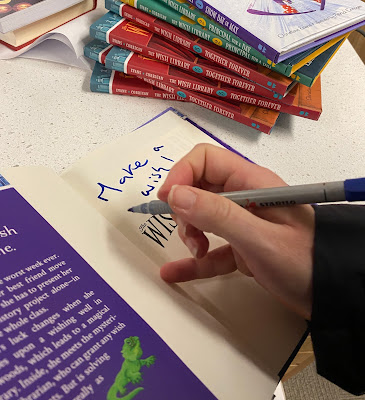
Image Source: Christine Evans
Christine Evans is the author of two picture books, Evelyn the Adventurous Entomologist illustrated by Yas Imamura (Innovation Press) and Emily’s Idea illustrated by Marta Álvarez Miguéns (Sounds True). Her chapter book series, The Wish Library, is out now (Albert Whitman). 

Christine Evans has jumped out of a plane once, windsurfed once, and water skied once. She much prefers books and writing to adrenaline sports. She is a British expat and has lived in California for over ten years with her husband and two young daughters. 


**********

Birth Stories for Books is an occasional feature of Dawn Babb Prochovnic's blog. Dawn is the author of multiple picture books including, Lucy's Blooms, Where Does a Cowgirl Go Potty?, Where Does a Pirate Go Potty?, and 16 books in the Story Time With Signs & Rhymes series. Dawn is a contributing author to the award-winning book, Oregon Reads Aloud, and a frequent presenter at schools, libraries, and educational conferences. Contact Dawn using the form at the left, or learn more at www.dawnprochovnic.com.